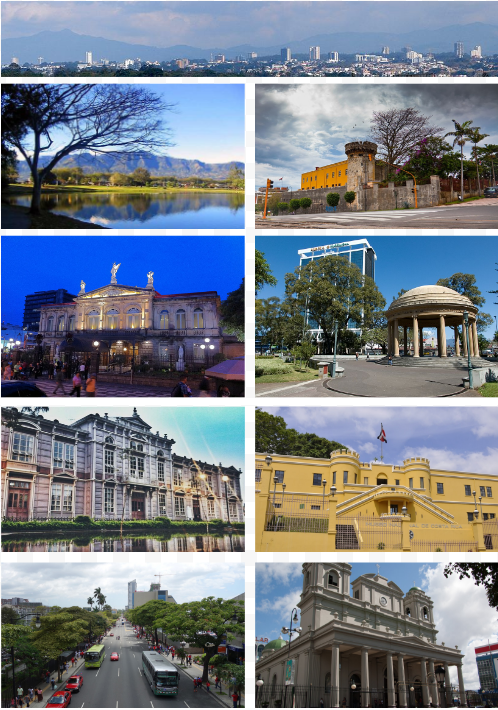
San Francisco, Costa Rica, sits at 1,200 meters above sea level in the country's central highlands, offering a tropical climate that is warm and humid year-round, with a pronounced rainy season from May to November and a drier season from December to April. This small town of 22,000 people is a quiet alternative to the capital, and expats tend to cluster in the San Francisco center, where daily life unfolds around local markets, family-run eateries, and tree-lined streets. The elevation moderates the heat, making afternoons pleasant even during the wettest months, and the compact size means most errands are a short walk or a quick bus ride away.
Living here is remarkably affordable, especially when compared to major U.S. cities. A one-bedroom apartment in the city center rents for $943/mo, while the same unit outside the center costs $759/mo; a three-bedroom in the center runs $1,933/mo, dropping to $1,296/mo on the outskirts. For a single adult, a budget tier total of $945/mo covers rent and basics, while a mid-range tier comes to $1,450/mo and a comfortable tier to $1,777/mo. Excluding rent, a single person spends about $1,007/mo, and a family of four around $3,748/mo. Utilities are a modest $95/mo, internet $59/mo, and a mobile plan $36/mo, while a monthly public transport pass is $66/mo and a gym membership $73/mo. Eating out is inexpensive: a meal at an inexpensive restaurant costs $12, a three-course meal for two at a mid-range restaurant is $61, and a cappuccino runs $4. The average monthly net salary locally is $1,021/mo, which puts the cost of living index at 58/100 relative to New York City, a figure that underscores how far a foreign income can stretch.
Safety and healthcare are practical considerations for anyone relocating. The safety index here is 68/100, with a crime index of 32/100, indicating a relatively low level of serious crime, though standard precautions are still wise. Healthcare quality is rated as fair, and while the public system is accessible, expats often budget for private care or international insurance. The air quality index is a healthy 35, and the town's small size means less traffic and noise than in larger cities, contributing to a sense of calm. English proficiency is limited, so learning Spanish will greatly ease daily interactions, from pharmacy visits to negotiating with landlords.
For those considering a longer stay, Costa Rica offers two clear pathways. The Pensionado Visa requires a minimum monthly income of $1,000/mo, making it a fit for retirees with a steady pension, while the Digital Nomad Visa demands $3,000/mo, catering to remote workers who can maintain that income. The nearest airport is SYQ, just 6 km away, which simplifies arrivals and departures. With an overall expat score of 64/100, a FIRE score of 66/100, and a retiree score of 51/100, San Francisco suits budget-conscious expats and early retirees who prioritize low costs and a mild climate over urban amenities. Digital nomads will find the infrastructure adequate, with an average internet speed of 25 Mbps, but the small expat community and limited English may require extra effort to build a social circle. This is a place for those who want an authentic, unhurried Costa Rican life, where the mountains meet the clouds and the pace of living is refreshingly slow.