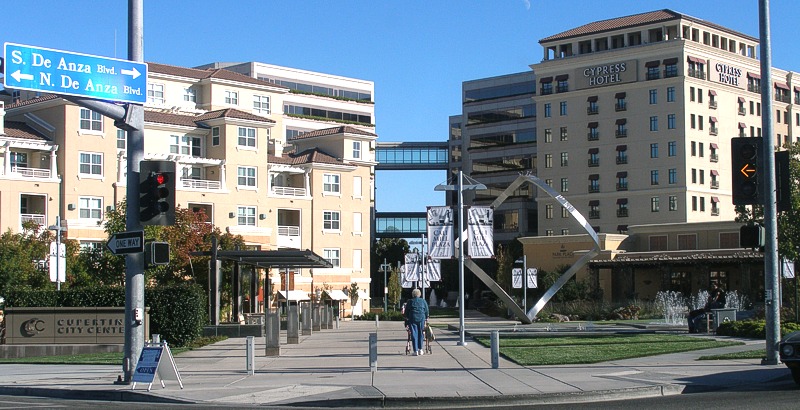
Cupertino sits in the heart of Silicon Valley, roughly 77 m above sea level in Santa Clara County, on Pacific time. Its Mediterranean climate delivers dry, warm summers and mild, wet winters, a rhythm that keeps outdoor life comfortable for most of the year. The city of about 60 thousand residents draws a steady stream of international arrivals, and the expat community here is large and active. Two neighborhoods in particular, Seven Springs and Monta Vista, have become the default landing spots for newcomers who want good schools, quiet streets, and easy access to the tech corridor.
Budgeting for Cupertino means confronting some of the highest housing costs in the country. A one-bedroom in the city center runs $2,567/mo, while the same apartment outside the center drops to $1,933/mo. Families face steeper numbers: $5,000/mo for a three-bedroom in the center, or $4,267/mo farther out. Beyond rent, a single adult spends about $1,750/mo, and a family of four about $6,200/mo. Utilities average $255/mo, internet $67/mo, and a mobile plan $62/mo. A monthly public transport pass costs $140/mo, a gym membership $35/mo, an inexpensive restaurant meal $25 per person, a mid-range three-course dinner for two $50, and a cappuccino $6. Against those figures, the average local net salary is $7,500/mo, and the cost of living index sits at 113 with New York City at 100. Depending on lifestyle, single adults land in tiers of roughly $1,942/mo, $2,975/mo, or $3,865/mo with rent included.
Safety is one of Cupertino's strongest selling points. The safety index reaches 83 out of 100, while the crime index is just 17 out of 100, a combination that lets residents walk and commute with little concern. Air quality registers 55, a middling score that reflects the broader Bay Area rather than any local industry. Healthcare quality is rated excellent, and English is widely spoken, which smooths everything from doctor visits to school meetings for newcomers who arrive without fluent English.
Getting to Cupertino is straightforward through Norman Y. Mineta San Jose International Airport, listed as SJC, only 10 km away. Immigration pathways exist for skilled workers, students, investors, and family members, though the specific route depends on individual circumstances. Internet speeds average 150 Mbps, fast enough for remote work and streaming. The city scores 76 out of 100 overall for expats and the same 76 for digital nomads, with a retiree score of 54 and a FIRE score of 41. That profile suits tech professionals, remote workers, and families tied to the region's employers, while retirees and aggressive early-retirement planners may find the math tighter than they would like.