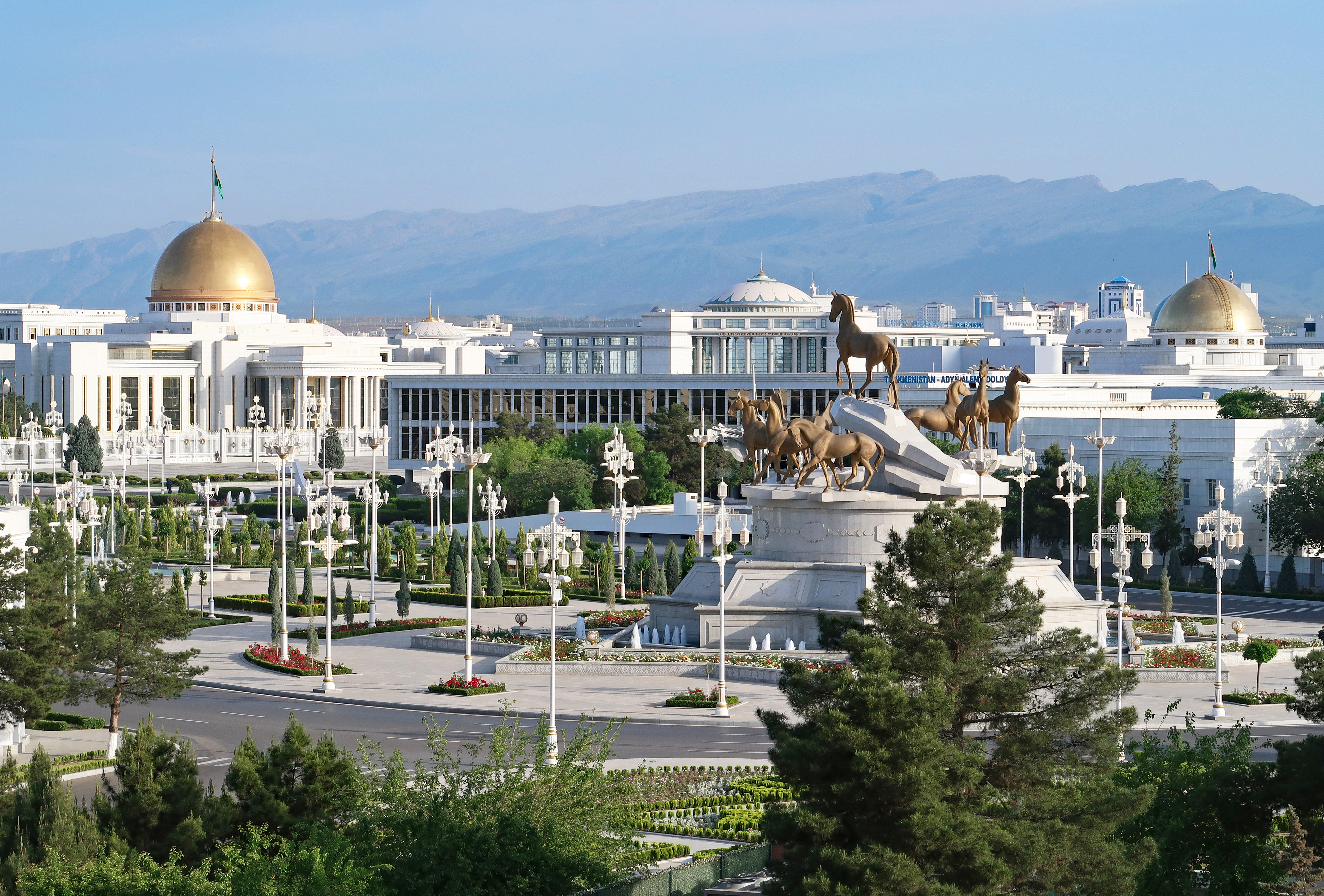
Ashgabat sits on the edge of the Karakum Desert, a marble-clad capital at 214 meters above sea level, where the climate is as extreme as the architecture. Summers are scorching, routinely exceeding 38°C, while winters are mild, hovering around 6°C, with little rainfall to break the dryness. For expats, the city is compact and manageable, with most choosing to live in Ashgabat Center, Berkararlyk, or Parahat, neighborhoods that offer proximity to amenities and a more familiar urban rhythm. The city's population of 127 thousand means it never feels overwhelming, and the nearest airport, ASB, is just 5 km away, making arrivals and departures relatively painless.
Living in Ashgabat comes with a stark reality: costs are high, but local wages are not. A one-bedroom apartment in the city center will set you back $1,414/mo, while the same outside the center is $1,000/mo. For a three-bedroom, expect $2,286/mo in the center and $1,929/mo outside. The average monthly net salary is just $750/mo, which means most locals struggle to afford the same lifestyle that expats might take for granted. A single person's monthly cost excluding rent is $1,850/mo, and when you factor in rent, the budget tier totals $1,743/mo, the mid-range tier $2,633/mo, and the comfortable tier $3,358/mo. Utilities run $571/mo, internet $103/mo, and a mobile plan $57/mo. Even a simple meal at an inexpensive restaurant costs $31, and a cappuccino will set you back $7. The cost of living index sits at 55/100 relative to New York City, which might sound moderate, but the gap between income and expenses is a defining feature.
Safety and healthcare are two areas where Ashgabat offers a mixed picture. The safety index is 50/100, and the crime index is 48/100, suggesting a city that is neither particularly dangerous nor notably safe, but rather average. Healthcare quality is rated as good, which is reassuring for expats, though the overall expat score of 65/100 reflects a generally acceptable, if not exceptional, experience. The air quality index is 72, which is moderate, and the city's desert location means dust and heat can be a factor. For those considering a longer stay, the retiree score is 51/100, and the digital nomad score is 42/100, indicating that while the basics are covered, the city is not a top choice for remote workers or retirees seeking a high level of comfort.
Visas for Turkmenistan are notoriously restrictive, and while specific programs are not detailed here, it's clear that the process requires patience and planning. Getting there is straightforward via ASB, the international airport just 5 km from the city center. This is a city that suits a particular kind of traveler: one who is drawn to the surreal, who can tolerate extreme heat, and who doesn't mind a small expat community and limited English proficiency. The FIRE score of 65/100 suggests that for those with outside income, the low cost of living relative to Western standards could be appealing, but the high absolute costs and low local wages mean that living like a local is not cheap. Ultimately, Ashgabat is a place of contrasts, where the gleaming white buildings and low crime belie the financial strain and bureaucratic hurdles that come with calling it home.