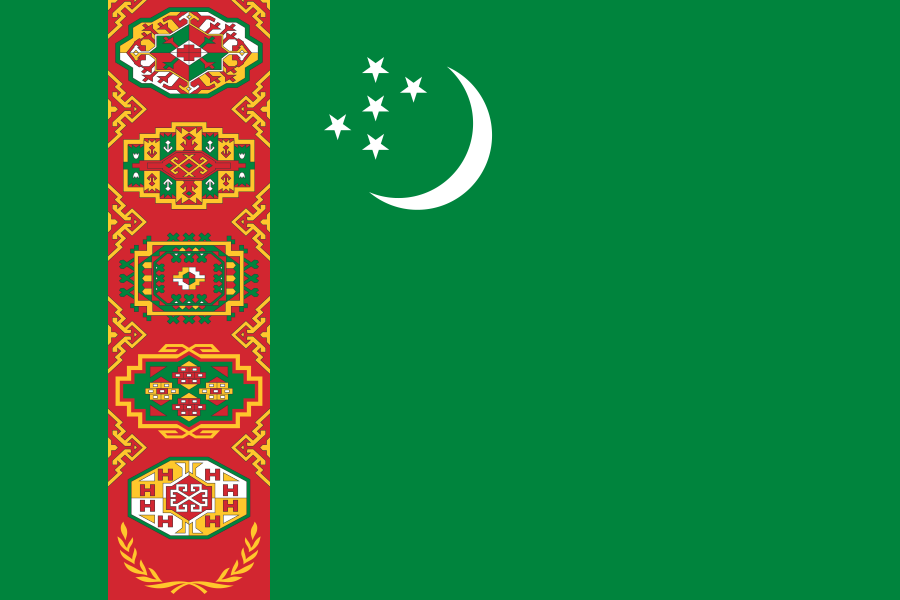
Turkmenistan
Data updated Oct 14, 2026
Overall Score
20.4
Challenging
Avg. Rent (1BR)
$1,043
-39% vs US Avg
Safety Index
58.4
COL Index
103.7
Overall Score
20.4
ChallengingEstimated Cost
$2,480/mo
single person, incl. rent
Verdict
Best for retirees
based on our recommended destinations
Turkmenistan is not a retirement or remote work destination, and the only people who end up here long-term are tied to an employer, usually in energy or diplomacy, with a sponsor handling the paperwork. If that's not your situation, skip the rest of this and look elsewhere.
The cost numbers look deceptively reasonable on paper: $1,824.80 a month for a single person before rent. But that average disrupts because Ashgabat pricing is distorted by import costs and state control over the exchange rate, not by an efficient local economy. Basic utilities on a 915 sq ft apartment run $571.43 a month, which is high for the region, and broadband internet costs $98.57 for a connection that averages just 26.94 Mbps nationally, slow by any standard. A mid-range dinner for two runs $85.71, closer to a European capital than a Central Asian one.
The friction here isn't inconvenience, it's structural. English proficiency is low, so daily life runs in Turkmen or Russian, and there's no infrastructure built around foreigners who don't speak either. Healthcare is the bigger issue: public funds mainly finance healthcare, but informal payments are widespread, leading to additional expenses for individuals. Bribery and informal payments inside the public system are documented and routine, so budget for under-the-table costs on top of whatever official fees exist.
For a US citizen who somehow ends up working there, the tax mechanics are straightforward even if getting there isn't. Turkmenistan taxes income at a flat 10%, and capital gains for individuals are taxed the same way, at 10%. Dividends for resident individuals are taxed at 10%. The US Foreign Earned Income Exclusion for 2026 sits at $132,900, with a foreign housing exclusion base of $21,264 and a cap of $39,870, and both should help shelter income at Turkmenistan's cost of living from US tax if you qualify under the physical presence or bona fide residence test. No US-Turkmenistan tax treaty exists, so don't assume treaty-based relief is available. Run this by a cross-border accountant before you sign anything, since the absence of a treaty changes how certain credits and elections interact with your US return.
Turkmenistan vs. the Central Asia average
Scores out of 10, shown as the gap between Turkmenistan and the average of the 4 other countries in Central Asia. 1 clear strength, 6 clear gaps.
- Air Quality+1.0
- Safety+0.2
- Tax Friendliness+0.1
- English Speaking0.0
- Public Transport-0.6
- Expat Community-1.4
- Residency Pathway-1.5
- Healthcare-2.3
- Internet Speed-2.6
- Cost of Living-6.9
🚚 Moving to Turkmenistan
Planning the move? Compare free quotes from international movers.
Get a free moving cost estimate for moving to Turkmenistan. Takes 10 seconds.
How much are you shipping?
When are you moving?
Powered by Sirelo. Free quotes from international movers.
We may earn a commission if you request quotes through this tool.
Recommended Destinations in Turkmenistan
Best for Retirees
Best for Geoarbitrage
Best for Remote Workers
- Capital
- Ashgabat
- Official Language
- Russian, Turkmen
- Time Zone
- UTC+05:00
- Region
- Asia
- Population
- 6,031,187
- Healthcare Index
- 23.7
- Internet Speed
- 26.94 Mbps
View on Interactive Map
Explore data visually
🏙️ Top Cities in Turkmenistan
Explore cost of living, walkability scores, and expat ratings for individual cities in Turkmenistan.
CoL Index: 31
Est. Total: ~$886/mo
CoL Index: 31
Est. Total: ~$730/mo
CoL Index: 55
Est. Total: ~$3,264/mo
CoL Index: 104
Est. Total: ~$1,685/mo
How far does $2,500 go in Turkmenistan?
With a monthly budget of $2,500, you can live comfortably in Turkmenistan. After accounting for an average rent of $$1,043, you have approximately $1,457remaining for daily expenses.
Calculate your FIRE timeline with these costs →💰 Cost of Living in Turkmenistan
Relative to New York City (NYC = 100). A lower number means it's cheaper.
Estimate the cost of shipping your belongings to Turkmenistan →
See how Turkmenistan's cost of living compares with Kazakhstan
🛒 Grocery & Family Costs
Family Costs
Can I afford to live in Turkmenistan?
Comfortable (1.0×): balanced baseline lifestyle. Adjusts day-to-day costs only — rent is unaffected.
Turkmenistan
You could save
132/mo
Monthly Costs
Attractiveness Scores
Based on national averages. City-level costs may vary. Browse cities in Turkmenistan →
⚕️ Healthcare System
Our Top Pick for Nomads: SafetyWing
Flexible, subscription-based health cover for remote workers in Turkmenistan.
Get Covered with SafetyWing →Looking for more options? Check Ekta.
An estimation of the overall quality of the health care system. Higher is better.
Quality & Affordability:
Turkmenistan's healthcare system is organized nationally, with the Ministry of Health and Medical Industry responsible for operations. Public funds mainly finance healthcare, but informal payments are widespread, leading to additional expenses for individuals.
Insurance Insights:
Public funds mainly finance healthcare, but informal payments are widespread, leading to additional expenses for individuals.
See how Turkmenistan's healthcare compares with Kazakhstan
🛂 Visa & Residency Pathways
🛂 Visa Services
Ready to apply for a Turkmenistan visa?
Get help with your application — tourist, long-stay, and residency visas processed online.
General Overview
Process & Requirements:
Turkmenistan has one of the most closed and 'difficult' immigration systems in the world. All foreign citizens must have a visa to enter, and the process requires an official letter of invitation from a sponsoring entity (e.g., a state-owned company) that has been approved by the State Migration Service. Independent travel is heavily restricted, and long-term residency is nearly impossible without being employed by a government-approved project or international organization. There are no independent, long-term visa categories like retirement, passive income, or digital nomad visas.
The entire system is designed for maximum state control, and there is very little public information available on official websites regarding long-term residency. The process is opaque and entirely dependent on the sponsoring organization's ability to navigate the state bureaucracy.
Residency & Citizenship Notes:
There is no pathway to permanent residency for foreign nationals. The concept does not exist within the Turkmen immigration framework. The pathway to citizenship is equally 'difficult' and practically non-existent for foreigners. While a law on citizenship exists, naturalization is exceedingly rare and usually reserved for individuals by presidential decree. Turkmenistan requires the renunciation of foreign citizenship upon naturalization. The closed nature of the state makes both permanent residency and citizenship impossible goals for expats.
🛂 Visa Matcher
See which Turkmenistan visas you qualify for
Answer 11 quick questions and get matched to the right visa for your situation.
Free · No signup required to see results
Detailed Visa Options
🧳 Tourist & Short-Stay Information
Extension Notes
Tourist visas are fixed to the dates of a pre-booked tour and cannot be extended, as the traveler must be accompanied by a guide at all times. Source: Turkmenistan State Migration Service policies.
General Visa Notes
US citizens must have a visa to enter Turkmenistan. To obtain a tourist visa, an applicant must first book a tour with a state-licensed travel agency, which will provide a letter of invitation. This process is mandatory and can be lengthy.
Official Source: View Source
🌴 Retirement / Passive Income Visa
This country does not have a dedicated retirement visa, but the following notes provide guidance on pathways for retirees.
Income Notes
Turkmenistan is one of the world's most closed countries and does not offer any form of retirement or passive income visa. All visas require a letter of invitation and long-term residency is extremely rare.
Official Source: https://migration.gov.tm/en/
Health Insurance Notes
Turkmenistan does not offer any retirement or passive income visa. For the rare instances where a long-term visa is granted, health insurance is mandatory and often must be purchased from the state insurance company.
Official Source: https://migration.gov.tm/en/
💻 Digital Nomad Visa
Income Notes
Turkmenistan does not have a digital nomad visa. It is known for having one of the world's most restrictive visa policies, and obtaining even a tourist visa requires a letter of invitation from a state-licensed travel agency. Independent remote work is not a possibility under the current system. Source: State Migration Service of Turkmenistan.
📈 Investor Visa
Investment Details
Investment Options & Notes
Turkmenistan allows for an investor visa for individuals who invest a minimum of $500,000 USD into the national economy. This is a rarely used route and involves significant government scrutiny. The process is not transparent. Source: Law of Turkmenistan 'On Migration'.
Path to Citizenship
Citizenship Notes
An investor can apply for citizenship after 7 years of continuous residency. The applicant must pass an exam on the constitution and the state language. Turkmenistan does not recognize dual citizenship. Source: Law of Turkmenistan 'On Citizenship'.
Many long-stay visas require proof of health insurance. Compare international health plans before you apply.
Compare health insuranceWe may earn a commission at no cost to you.
🛡️ Safety & Stability
An estimation of overall safety level. Higher is better.
World Bank political stability estimate, rescaled to 0-100. Higher is better.
Safety Notes:
Crime Rate: Strict laws deter most crime.
Types of Crime: Rare petty theft or bribery attempts.
Kidnapping Risk: Negligible; no documented cases.
🏦 Taxation & Finance
🏦 Tax Snapshot
FEIE Interaction
FTC Utility: low
The Turkmenistan personal income tax rate of 10% is well below the US top marginal rate, so foreign tax credits generated rarely eliminate the full US tax liability. Most US expats rely on the FEIE rather than the FTC. No US-Turkmenistan tax treaty exists to coordinate tax treatment or provide reduced rates.
Presence Day Count Notes
The bona fide residence test is difficult to establish in Turkmenistan given severe restrictions on foreign residents, limited visa categories for long-term stays, and the closed nature of the country. Most US expats working in Turkmenistan - primarily in the energy sector - qualify via the physical presence test by being present at least 330 days in a 12-month period.
FBAR Trigger Notes
FBAR filing is required if aggregate balances in foreign financial accounts exceed $10,000 at any point during the calendar year. Banking access in Turkmenistan is highly restricted for foreigners and the manat (TMT) is subject to official and unofficial exchange rate disparities. Account holders should ensure balances are converted at the official rate for FBAR purposes. FATCA compliance by Turkmen banks is minimal given the lack of a Model 1 or Model 2 IGA with the US.
401k/IRA Treatment
Pension Income
Foreign pension income received by Turkmenistan tax residents is treated as taxable income subject to the 10% flat rate. Domestic state pensions may receive preferential treatment under local rules, but foreign private pensions have no exemption.
Locally TaxedSocial Security
No totalization agreement or income tax treaty between the US and Turkmenistan. US Social Security benefits received by a Turkmenistan tax resident are not protected by treaty and may be subject to local taxation at the 10% rate on the portion treated as taxable income.
Locally TaxedRoth Distributions
No US-Turkmenistan tax treaty exists. Roth distributions are not formally recognized as tax-free under Turkmen law. A tax resident receiving Roth distributions could potentially face taxation at the 10% rate, though enforcement on foreign-source income is limited in practice given Turkmenistan's opaque tax administration.
Locally TaxedUS 401k/IRA Distributions
The United States and Turkmenistan do not have a bilateral income tax treaty. US retirement distributions received by a Turkmenistan tax resident would likely be treated as foreign-source income subject to the 10% flat personal income tax rate. No treaty protection exists to reduce or exempt such distributions.
Locally TaxedCapital Gains Tax
Turkmenistan does not maintain a separate capital gains tax regime. Gains realized by individuals are generally treated as ordinary income and taxed at the flat 10% personal income tax rate. Corporate gains are subject to the corporate income tax rate of 8% for most domestic enterprises, though rates vary by sector.
No standalone capital gains tax exists. Individual gains are folded into personal income and taxed at the flat 10% rate. Corporate gains are taxed under the standard corporate income tax framework.
Dividend Tax Rate
Dividends paid to non-residents are subject to withholding tax. For resident individuals, dividends are generally included in taxable income and subject to the 10% flat personal income tax rate. The withholding rate on dividends paid to foreign entities is 15% under domestic law, though treaty rates may reduce this where applicable. Turkmenistan has a limited tax treaty network.
flat
Rate: 10.0%
Applicable to resident individuals - taxed at the standard 10% personal income tax rate.
withholding
Rate: 15.0%
Domestic withholding rate on dividends paid to non-residents. Treaty rates may apply where a bilateral tax treaty is in force.
Tax Treaties Notes:
No US-Turkmenistan tax treaty. Strict government control limits data availability.
Retiree Tax Benefits:
Visa restrictions make retirement impractical for foreigners.
Cost Savings vs. U.S.:
Nominal costs low, but access to goods/services is limited.
Pick between Form 2555 (Foreign Earned Income Exclusion) and Form 1116 (Foreign Tax Credit) with an expat tax service.
Get help with my expat taxesWe may earn a commission at no cost to you.
Recommended services for Turkmenistan
Recommended Partner
Fidelity →See how Turkmenistan's taxes compares with Kazakhstan
☀️ Climate & Environment
Our proprietary index measuring annual average PM2.5 concentration. Lower is better (0-5 is good).
Our proprietary index for drinking water quality and sanitation. Higher is better.
Seasonal Variations:
Turkmenistan has an arid climate with hot, dry summers and mild to cold winters. Rainfall is scarce and occurs mainly in the spring and autumn.
😊 Quality of Life
Cultural Amenities:
Museums & Cultural Institutions
Turkmenistan is home to several museums, including the Turkmen Carpet Museum in Ashgabat, which showcases the country's rich carpet-weaving tradition.
The National Museum of Fine Arts offers exhibits on Turkmen art and culture.
Performing Arts
Turkmenistan has a rich tradition of music and dance, with genres like traditional folk music and dance playing significant roles.
The Turkmen National Theatre hosts various performances, including plays and musical shows.
Cultural Festivals
The Turkmen Carpet Day, celebrated in May, honors the country's carpet-weaving heritage with exhibitions and performances.
The Independence Day on October 27th is celebrated with various cultural events and performances.
Culinary Culture
Turkmen cuisine includes dishes like plov (rice pilaf), shashlik (grilled meat skewers), and manti (steamed dumplings).
The country's food reflects its Central Asian heritage and regional influences.
🌐 Infrastructure & Connectivity
Our proprietary ranking of public transit accessibility and reliability.
Internet Reliability:
Turkmenistan offers very limited internet infrastructure with restricted access, not suitable for international remote work.
Speed & Quality: Fixed broadband averages 26.94 Mbps, with very limited coverage and heavy government restrictions.
Availability: Limited to major cities with poor quality and restricted international access.
Cost: Varies widely due to government controls, often expensive relative to quality.
Reliability for Remote Work: Not suitable for remote work due to severe government restrictions on internet access, blocked international services, and unreliable infrastructure. Tourism and business visas are restrictive.
Transportation Network:
Turkmenistan has a centralized transportation system with government-controlled infrastructure and limited public access.
Roads: Decent highway network connecting major cities, but rural areas are less well-served.
Rail: State-owned railway system connects major cities and extends to neighboring countries for freight transport.
Domestic Travel: Domestic flights available but heavily regulated; most citizens rely on buses and shared transportation.
Recommended services for Turkmenistan
Recommended Partner
Traveling Mailbox →Frequently Asked Questions about Turkmenistan
Click any question to expand the answer.
📚 Related Reading
Share This Guide
Turkmenistan's rules change. We'll tell you when.
Visa, tax, and cost updates for Turkmenistan, before they catch you out. Free with RA Postcards.
By submitting your email address, you will receive a free subscription to RA Postcards and special offers from Rewire Abroad and our affiliates. You can unsubscribe at any time, and we encourage you to read more about our Privacy Policy.