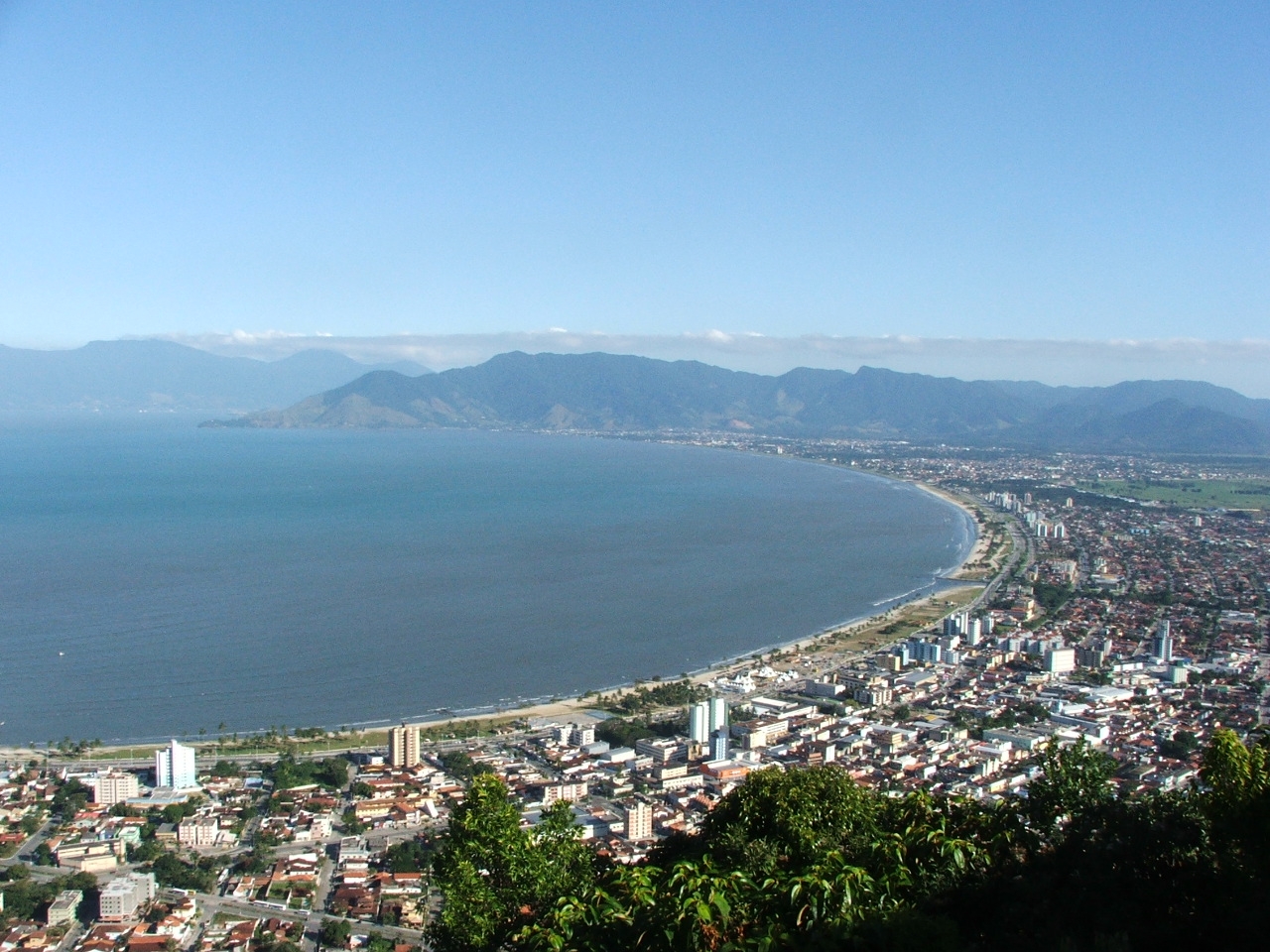
Caraguatatuba sits on Brazil's southeastern coast at just 2 m above sea level, in the state of São Paulo, where the climate is tropical and the timezone is America/Sao_Paulo. The city holds a population of 53 thousand, small enough that daily life stays unhurried but large enough to support a working infrastructure. Expats tend to settle in Martim de Sa, Indaia, and Tabatinga, three neighborhoods that balance residential calm with access to the shoreline and local commerce. The overall expat score of 85/100 reflects a place that rewards those who value warmth, low density, and a coastal rhythm over big-city intensity.
Living costs here are modest by global standards. A one-bedroom apartment in the city centre rents for $418/mo, while outside the centre it drops to $233/mo. Three-bedroom units run $864/mo in the centre and $525/mo outside it. Utilities average $66/mo, internet $23/mo, and a mobile phone plan $13/mo. A monthly public transport pass costs $23/mo and a gym membership $21/mo. Eating out is affordable: an inexpensive restaurant meal is $7 per person, a mid-range three-course meal for two is $29, and a cappuccino is $2. For a single adult, monthly costs excluding rent come to $400/mo, or $1,045/mo for a family of four. Budget, mid-range, and comfortable tiers for a single adult, rent included, are $361/mo, $549/mo, and $824/mo respectively. The cost of living index is 31/100 against New York City at 100. Local wages tell a different story: average monthly net salary is $336/mo, so many residents rely on shared housing, family networks, or remote income to bridge the gap.
Safety is a relative strength, with a safety index of 68/100 and a crime index of 32/100, where lower is safer. The air quality index is 45, a moderate reading that reflects the coastal setting rather than heavy industry. Healthcare quality is rated Good, which matters for retirees and long-stay residents who want dependable care without traveling far. The expat community is small, and English proficiency is limited, so learning Portuguese transforms everyday errands, medical visits, and friendships. Average internet speed is 25 Mbps, adequate for messaging and browsing, though heavier remote work may require patience or a backup connection.
For visas, the retirement route is VITEM XIV, which requires a minimum monthly income of $2,000/mo. The Brazil Digital Nomad Visa requires a minimum monthly income of $1,500/mo. Getting there means flying into the region and continuing by road along the coast, a journey that rewards travelers who plan ground transfers in advance. The city suits budget-conscious retirees, slow-living remote workers, and anyone drawn to a tropical shore where the digital nomad score is 63/100, the retiree score is 69/100, and the FIRE score is 87/100. It is not a place for those who need a large expat bubble or fluent English at every counter, but for the right person, the numbers and the pace align.