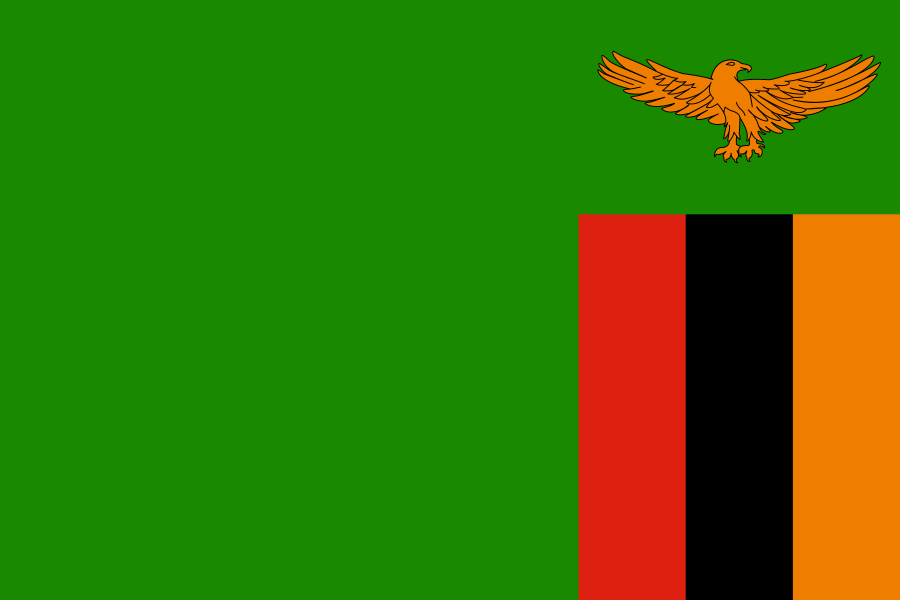
Zambia
Data updated Oct 14, 2026

Overall Score
41.4
Fair
Avg. Rent (1BR)
$475
-72% vs US Avg
Safety Index
48.3
COL Index
33.8
Overall Score
41.4
FairEstimated Cost
$852/mo
single person, incl. rent
Verdict
Best for retirees
based on our recommended destinations
Zambia works for a narrow slice of people: those on a fixed retirement income who want genuine affordability and don't need a fast visa process for remote work, because there's no digital nomad visa here. There is a retirement or passive-income visa, which is the realistic path for most people reading this, not a formal laptop-and-coffee-shop arrangement. This is a country for someone comfortable with Southern Africa generally, who wants a lower cost base and isn't trying to replicate a US suburb with better weather.
The numbers are low. A single person covers living costs at roughly $706 a month before rent, which gives a sense of how far your money stretches in Zambia. Internet is $59 for unlimited broadband, and average download speeds sit around 64 Mbps, and a mobile plan with 10GB runs about $11. That's the marketing pitch, and it's basically true at face value. What the pitch leaves out is that this is the cost of local-standard living, not the cost of replicating Western-grade services, and the gap between those two things is where your budget actually goes.
The friction shows up in healthcare, not in grocery prices. Public healthcare services are available in Zambia, but resource limitations mean many expats end up seeking private care or paying out of pocket for anything serious, and public expenditure on health has historically run under 3.5% of GDP, among the lowest in southern Africa. Infrastructure gaps are a real planning variable, not a hypothetical. Budget hundreds of dollars a month extra for private healthcare and insurance that actually covers evacuation, because the baseline cost-of-living numbers don't include it.
For US tax purposes, your worldwide income is still reportable to the IRS regardless of where you live, and the Foreign Earned Income Exclusion lets you exclude up to $132,900 of foreign earned income for 2026 if you qualify under the physical presence or bona fide residence test. There's a foreign housing exclusion on top of that, with a base amount of $21,264 and a cap of $39,870 for 2026, which can matter if your rent is being paid as part of a work arrangement rather than out of pocket. There is no US-Zambia tax treaty, so don't assume treaty relief on dividends or pensions without a cross-border accountant confirming it directly, and don't plan around double-taxation relief you haven't verified exists.
Zambia vs. the East Africa average
Scores out of 10, shown as the gap between Zambia and the average of the 17 other countries in East Africa. 4 clear strengths, 2 clear gaps.
- English Speaking+4.3
- Internet Speed+1.5
- Residency Pathway+1.0
- Safety+0.9
- Air Quality+0.4
- Expat Community+0.2
- Tax Friendliness+0.1
- Housing Affordability-0.1
- Cost of Living-0.3
- Healthcare-0.7
- Public Transport-0.9
🚚 Moving to Zambia
Planning the move? Compare free quotes from international movers.
Get a free moving cost estimate for moving to Zambia. Takes 10 seconds.
How much are you shipping?
When are you moving?
Powered by Sirelo. Free quotes from international movers.
We may earn a commission if you request quotes through this tool.
Recommended Destinations in Zambia
Best for Retirees
Best for Geoarbitrage
Best for Remote Workers
- Capital
- Lusaka
- Official Language
- English
- Time Zone
- UTC+02:00
- Region
- Africa
- Population
- 18,383,956
- Healthcare Index
- 26.9
- Internet Speed
- 64.09 Mbps
- Climate Zones
- tropical
View on Interactive Map
Explore data visually
🏙️ Top Cities in Zambia
Explore cost of living, walkability scores, and expat ratings for individual cities in Zambia.
CoL Index: 36
Est. Total: ~$1,027/mo
CoL Index: 35
Est. Total: ~$656/mo
CoL Index: 38
Est. Total: ~$1,720/mo
CoL Index: 28
Est. Total: ~$560/mo
CoL Index: 31
Est. Total: ~$750/mo
CoL Index: 34
Est. Total: ~$1,180/mo
CoL Index: 24
Est. Total: ~$600/mo
How far does $1,500 go in Zambia?
With a monthly budget of $1,500, you can live comfortably in Zambia. After accounting for an average rent of $$475, you have approximately $1,025remaining for daily expenses.
Calculate your FIRE timeline with these costs →💰 Cost of Living in Zambia
Relative to New York City (NYC = 100). A lower number means it's cheaper.
Relative to New York City (NYC = 100). A lower number means rent is cheaper.
Relative to New York City (NYC = 100). A lower number means groceries are cheaper.
Relative to New York City (NYC = 100). A lower number means eating out is cheaper.
Cost Comparison Notes:
Summary of cost of living in Zambia: The estimated monthly costs for a family of four are 6,820,759.1Col$ ($1,873.5), excluding rent. The estimated monthly costs for a single person are 1,868,852.7Col$ ($513.3), excluding rent.
Estimate the cost of shipping your belongings to Zambia →
See how Zambia's cost of living compares with Mauritius
🛒 Grocery & Family Costs
Family Costs
Can I afford to live in Zambia?
Comfortable (1.0×): balanced baseline lifestyle. Adjusts day-to-day costs only — rent is unaffected.
Zambia
You could save
1,820/mo
Monthly Costs
Attractiveness Scores
Based on national averages. City-level costs may vary. Browse cities in Zambia →
⚕️ Healthcare System
Our Top Pick for Nomads: SafetyWing
Flexible, subscription-based health cover for remote workers in Zambia.
Get Covered with SafetyWing →Looking for more options? Check Ekta.
An estimation of the overall quality of the health care system. Higher is better.
Quality & Affordability:
Zambia's health service delivery system operates on three levels: community-level services, provincial or general hospitals, and central or specialist hospitals. Public healthcare services are available, but resource limitations may lead individuals to seek private care, resulting in significant out-of-pocket costs.
Insurance Insights:
Public healthcare services are available, but resource limitations may lead individuals to seek private care, resulting in additional expenses.
See how Zambia's healthcare compares with Mauritius
🛂 Visa & Residency Pathways
🛂 Visa Services
Ready to apply for a Zambia visa?
Get help with your application — tourist, long-stay, and residency visas processed online.
General Overview
Process & Requirements:
Zambia's residency system is 'complex' and primarily aimed at investors and skilled employees. The most common route is to obtain an Employment Permit, which requires sponsorship from a company in Zambia. The employer must justify the need for a foreign worker. For investors, establishing a business with a minimum investment (e.g., $250,000 for a standard investor's permit) provides a path to residency. There is no specific visa for retirees, but a person with significant, verifiable income may be able to apply for a permit as a 'person of independent means,' though this is a discretionary category.
The process is managed by the Department of Immigration and is known for being bureaucratic and slow. The high investment thresholds and focus on employment make it challenging for those without a direct economic contribution to make (URL: https://www.zambiaimmigration.gov.zm/).
Residency & Citizenship Notes:
The pathway to permanent residency is 'complex' due to the ten-year wait. The pathway to citizenship is also 'complex'. An individual can apply for naturalization after ten years of residence. They must be of good character and have a basic knowledge of an official language. The main complexity is that Zambia's constitution does not permit dual citizenship for naturalized citizens. A person must renounce their previous citizenship. This requirement is a major barrier for most potential applicants.
🛂 Visa Matcher
See which Zambia visas you qualify for
Answer 11 quick questions and get matched to the right visa for your situation.
Free · No signup required to see results
Detailed Visa Options
🧳 Tourist & Short-Stay Information
Extension Notes
A single-entry visa can be extended up to a total of 90 days within a 12-month period. This is done at an immigration office within Zambia. Source: Zambia Department of Immigration.
General Visa Notes
US citizens require a visa. They can obtain one on arrival or apply for an e-Visa online beforehand. The KAZA Univisa is also an option, covering both Zambia and Zimbabwe. A passport with six months' validity and two blank pages is required.
Official Source: View Source
🌴 Retirement / Passive Income Visa
Income Notes
Zambia offers a Retirement Permit to persons over 60. Applicants must provide evidence of 'guaranteed income' from an external source sufficient to support themselves. While no amount is fixed by law, proof of regular pension or fund transfers is required.
Official Source: https://www.zambiaimmigration.gov.zm/our-services/permits/retirement-permit/
Health Insurance Notes
For the Retirement Permit, applicants must provide proof of a comprehensive medical insurance or healthcare scheme that provides coverage in Zambia. This is a required document for the application.
Official Source: https://www.zambiaimmigration.gov.zm/our-services/permits/retirement-permit/
💻 Digital Nomad Visa
Income Notes
Zambia does not have a digital nomad visa program. Long-term stays for work purposes require an Employment Permit, which must be sponsored by an employer registered in Zambia. There is no category for independent remote work.
Official Source: View Source
📈 Investor Visa
Investment Details
Investment Options & Notes
An investor must obtain an investment license by showing an intended investment of at least $250,000 USD into a Zambian business. This is an active investment route. A lower tier exists for certain priority sectors. Source: Zambia Development Agency Act, 2014.
Path to Citizenship
Citizenship Notes
After 10 years of legal residence, an investor can apply for citizenship. The process is lengthy and discretionary. Dual citizenship is permitted. Source: The Constitution of Zambia.
Many long-stay visas require proof of health insurance. Compare international health plans before you apply.
Compare health insuranceWe may earn a commission at no cost to you.
🛡️ Safety & Stability
An estimation of overall safety level. Higher is better.
An estimation of the overall level of crime. Lower is better.
World Bank political stability estimate, rescaled to 0-100. Higher is better.
🏦 Taxation & Finance
🏦 Tax Snapshot
FEIE Interaction
FTC Utility: medium
Zambia top marginal rate is 37%, which exceeds the top US federal rate of 37% only marginally. For middle-income earners, Zambian effective rates may be lower than US rates, reducing FTC utility. No US-Zambia tax treaty exists, so no treaty-based FTC coordination applies. FEIE may be more advantageous than FTC for most earners.
Presence Day Count Notes
Standard IRS 330-day physical presence test applies for Zambia. No unusual counting rules. Zambia does not restrict exit or create constructive presence issues.
FBAR Trigger Notes
FBAR filing required for US persons with aggregate foreign financial account balances exceeding $10,000 at any point during the calendar year. Zambian kwacha accounts at local banks such as Zanaco, FNB Zambia, and Stanbic Zambia all qualify. No Zambia-specific FBAR complications noted.
401k/IRA Treatment
Pension Income
Pension income is taxable in Zambia under the normal progressive schedule. The Zambia Revenue Authority treats pension receipts as income subject to PAYE withholding. Rates range from 0% to 37% depending on annual income level in ZMW.
Locally TaxedSocial Security
No US-Zambia totalization or income tax treaty exists. US Social Security benefits received by a Zambia resident could be subject to Zambian income tax as foreign pension or annuity income.
Locally TaxedRoth Distributions
Roth distributions have no special recognition in Zambian tax law. Absent a US-Zambia tax treaty, Roth distributions would be taxable as income in Zambia if the recipient is resident. In practice, Zambia taxes employment and pension income; treatment of Roth as capital return vs income is uncertain and would depend on ZRA interpretation.
Locally TaxedUS 401k/IRA Distributions
Zambia has no income tax treaty with the United States. US 401(k) and IRA distributions received by a Zambia tax resident would be treated as foreign-source income and assessed under the normal progressive PAYE scale (0% to 37%). No treaty protection exists to limit Zambian taxation.
Locally TaxedCapital Gains Tax
Zambia imposes Property Transfer Tax (PTT) at 5% on gains from disposal of land, shares, mining rights, and intellectual property. PTT applies to the realized gain (sale price minus cost). It is not a capital gains tax in the traditional sense but functions as one. Corporate disposals are subject to the same 5% PTT rate.
Zambia does not have a standalone capital gains tax. Instead, the Property Transfer Tax Act imposes a 5% tax on the realized gain from transfers of land, shares, mining rights, and intellectual property. The tax applies to both individuals and corporations.
Dividend Tax Rate
Dividends paid to non-residents are subject to withholding tax at 15%. Dividends paid to Zambian resident individuals are also subject to 15% withholding tax, which is a final tax. Dividends paid between Zambian resident companies may qualify for reduced or nil withholding in certain circumstances under applicable treaties.
withholding
Rate: 15.0%
Standard withholding rate for dividends paid to both residents and non-residents. Acts as final tax for individuals.
Pick between Form 2555 (Foreign Earned Income Exclusion) and Form 1116 (Foreign Tax Credit) with an expat tax service.
Get help with my expat taxesWe may earn a commission at no cost to you.
Recommended services for Zambia
Recommended Partner
Fidelity →See how Zambia's taxes compares with Mauritius
☀️ Climate & Environment
Climate Zones:
Our proprietary index measuring annual average PM2.5 concentration. Lower is better (0-5 is good).
Our proprietary index for drinking water quality and sanitation. Higher is better.
Seasonal Variations:
Zambia has a climate, significantly moderated by altitude. The country experiences three distinct seasons: the cool and dry season from May to August, the hot and dry season from September to October, and the rainy season from November to April. Average temperatures range from 21°C to 35°C, with cooler temperatures in the highlands. The rainy season is characterized by thunderstorms and heavy rainfall, which can impact travel plans.
😊 Quality of Life
Cultural Amenities:
Museums & Cultural Institutions
The Lusaka National Museum offers exhibits on Zambia's history, from pre-colonial times to contemporary art, including a replica of the Broken Hill Man skull, a significant hominid fossil discovered in Africa.
The Choma Museum and Crafts Centre showcases the heritage of the Tonga people, displaying traditional crafts like beadwork, musical instruments, and pottery, and supports local artisans through craft projects.
The Livingstone Museum, located near Victoria Falls, is the oldest and largest museum in Zambia, featuring collections on archaeology, ethnography, and the history of David Livingstone's explorations.
Performing Arts
Traditional Zambian music and dance are integral to cultural ceremonies and festivals. Instruments like the silimba (a type of xylophone) and dances such as the Chisamba and Mbewe are performed during community events.
Contemporary Zambian music blends traditional elements with modern genres. Artists like Maiko Zulu and Afro-Zambia are popular figures in the music scene, blending traditional elements with modern genres, thereby attracting younger audiences and keeping the cultural heritage alive.
Cultural Festivals
Zambia celebrates numerous traditional ceremonies throughout the year. The Kuomboka Festival, of the Lozi people, marks the migration of the king from the floodplains to higher ground during the rainy season.
The Shimunenga Ceremony of the Ila people in Namwala District is celebrated during the full moon in September or October, featuring traditional songs, dances, and a mock lion hunt.
The Lusaka Food and Drink Festival is an annual event showcasing Zambian cuisine, offering a variety of traditional dishes and modern fusion creations.
Culinary Culture
Nshima, a staple food made from maize flour, is commonly served with relish such as vegetables, beans, or meat.
Vitumbuwa are deep-fried dough balls enjoyed as a snack or dessert.
Zambian cuisine reflects the country's diverse ethnic groups, with regional variations in dishes and cooking methods.
🌐 Infrastructure & Connectivity
Our proprietary ranking of public transit accessibility and reliability.
Internet Reliability:
Zambia has moderate internet infrastructure with ongoing improvements in urban areas.
Speed & Quality: Fixed broadband averages around 64.09 Mbps, with expanding fiber networks.
Availability: Good coverage in Lusaka and major cities, limited rural connectivity.
Cost: Moderate pricing for the region, typically $25-45/month.
Reliability for Remote Work: Adequate for basic remote work in urban areas, with improving infrastructure supporting economic development.
Transportation Network:
Zambia has developing transportation infrastructure as a landlocked country with ongoing regional connectivity projects.
Roads: Road network connects major cities but many routes are unpaved; seasonal conditions affect accessibility.
Rail: Rail network connects to neighboring countries providing access to ports.
Domestic Travel: Domestic flights available; buses provide primary intercity transport.
Recommended services for Zambia
Recommended Partner
Traveling Mailbox →Frequently Asked Questions about Zambia
Click any question to expand the answer.
Share This Guide
Zambia's rules change. We'll tell you when.
Visa, tax, and cost updates for Zambia, before they catch you out. Free with RA Postcards.
By submitting your email address, you will receive a free subscription to RA Postcards and special offers from Rewire Abroad and our affiliates. You can unsubscribe at any time, and we encourage you to read more about our Privacy Policy.