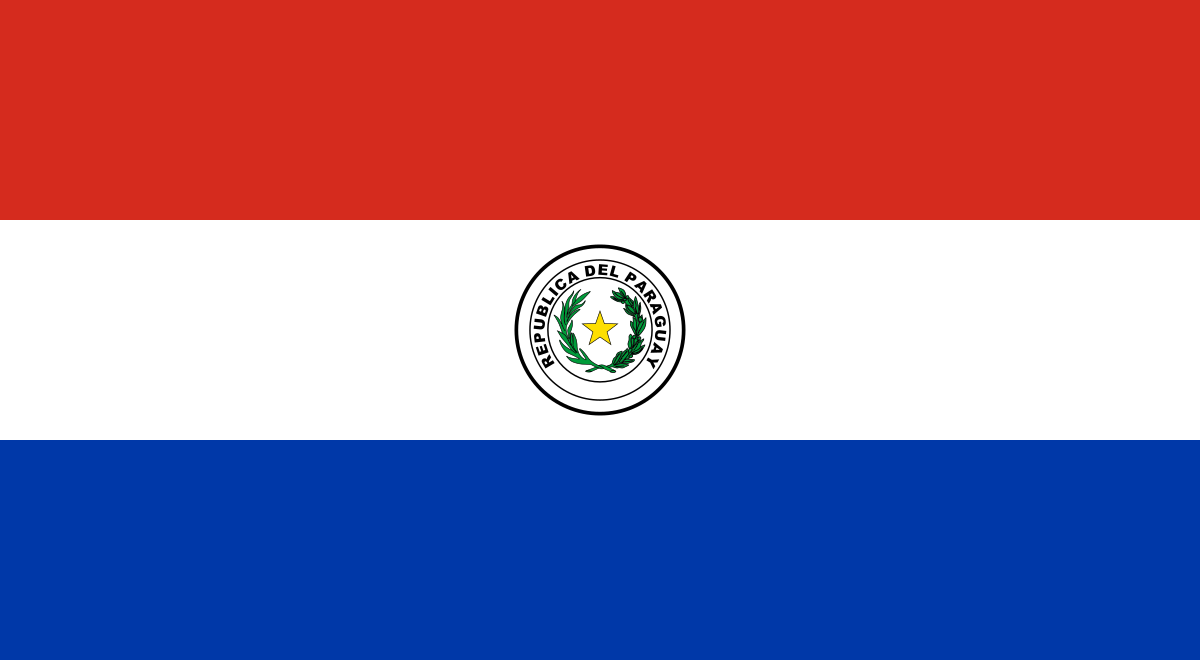
Paraguay
Data updated Oct 14, 2026

Overall Score
65.1
Excellent
Avg. Rent (1BR)
$453
-73% vs US Avg
Safety Index
48.2
COL Index
33.1
Overall Score
65.1
ExcellentEstimated Cost
$841/mo
single person, incl. rent
Verdict
Best for retirees
based on our recommended destinations
Paraguay works for a specific type of expat: someone who wants the lowest entry bar in South America for residency, doesn't need English spoken around them, and is comfortable being somewhere few other Americans bother to go. The retirement and passive-income visa has one of the lightest income thresholds on the continent, and there's now a dedicated digital nomad residency pegged to just $3,000 a month in income (in USD), which is low compared to most competing programs in the region. This is not the country for someone who wants polish, walkability, or a built-in community of fellow expats to lean on. It's for someone chasing low cost and low bureaucracy who can function in Spanish or is willing to learn it fast, since English proficiency here is low even in Asunción.
The cost numbers back up the pitch but need context. Numbeo puts a single person's monthly costs excluding rent at roughly $546.20, and that number is real and verifiable, not a lifestyle-blog exaggeration. What the marketing glosses over is that this number assumes local-market living: a $6.43 lunch, $35 monthly transit pass, $21.43 broadband. It does not assume imported goods, private international schooling (international primary tuition averages nearly $4,900 a year), or a car, since a new compact runs upward of $17,000. Cheap base costs, but the moment you want Western conveniences the gap narrows fast. Internet is a genuine bright spot, though, with average fixed broadband speeds around 177.86 Mbps, well above what the base cost of living would suggest.
The friction shows up mainly in healthcare. The system relies heavily on public funding, but inefficiencies necessitate reforms to enhance coverage and reduce out-of-pocket expenses. Historically Paraguay has spent far less per capita on health than most of Latin America, access outside cities is inconsistent, and private insurance penetration is low, meaning most private care is paid fee-for-service out of pocket rather than through a plan. If you have ongoing medical needs, budget for private care in Asunción specifically, not the national average.
For US tax purposes, Paraguay's domestic income tax tops out at 10% on personal income, with brackets at 8% up to PYG 50,000,000 and 9% up to PYG 150,000,000 below that, plus a flat 8% capital gains rate, all low relative to what you're used to. There is no confirmed US-Paraguay income tax treaty on record, so don't assume treaty relief exists. What does the heavy lifting for most Americans here is the Foreign Earned Income Exclusion, $132,900 for 2026, plus the foreign housing exclusion with a 2026 base of $21,264 and a cap of $39,870. Given how far a few thousand dollars a month stretches in Paraguay, a remote worker qualifying for the FEIE can plausibly owe close to nothing in US federal income tax on earned income, as long as they meet the physical presence or bona fide residence test. You still file every year regardless. Note that ETIAS is not yet operating for Europe-bound travel and has no confirmed start date, while the EU's Entry/Exit System (EES) has been live since October 12, 2025, which is a separate matter from Paraguay residency but relevant if your travel plans route through Europe.
Paraguay vs. the South America average
Scores out of 10, shown as the gap between Paraguay and the average of the 12 other countries in South America. 4 clear strengths, 2 clear gaps.
- Healthcare+2.5
- Tax Friendliness+1.5
- Safety+1.2
- Residency Pathway+0.9
- Cost of Living+0.3
- Air Quality+0.2
- Housing Affordability+0.1
- Internet Speed0.0
- Expat Community-0.3
- Public Transport-0.6
- English Speaking-2.1
🚚 Moving to Paraguay
Planning the move? Compare free quotes from international movers.
Get a free moving cost estimate for moving to Paraguay. Takes 10 seconds.
How much are you shipping?
When are you moving?
Powered by Sirelo. Free quotes from international movers.
We may earn a commission if you request quotes through this tool.
Recommended Destinations in Paraguay
Best for Retirees
Best for Geoarbitrage
Best for Remote Workers
- Capital
- Asunción
- Official Language
- Guaraní, Spanish
- Time Zone
- UTC-04:00
- Region
- Latin America
- Population
- 7,132,530
- Healthcare Index
- 73.8
- Internet Speed
- 177.86 Mbps
- Climate Zones
- subtropical
View on Interactive Map
Explore data visually
🏙️ Top Cities in Paraguay
Explore cost of living, walkability scores, and expat ratings for individual cities in Paraguay.
CoL Index: 35
Est. Total: ~$1,225/mo
CoL Index: 43
Est. Total: ~$923/mo
CoL Index: 37
Est. Total: ~$900/mo
CoL Index: 38
Est. Total: ~$870/mo
CoL Index: 35
Est. Total: ~$1,018/mo
CoL Index: 42
Est. Total: ~$795/mo
CoL Index: 66
Est. Total: ~$1,974/mo
CoL Index: 29
Est. Total: ~$733/mo
CoL Index: 33
Est. Total: ~$898/mo
CoL Index: 25
Est. Total: ~$700/mo
CoL Index: 33
Est. Total: ~$1,000/mo
How far does $1,500 go in Paraguay?
With a monthly budget of $1,500, you can live comfortably in Paraguay. After accounting for an average rent of $$453, you have approximately $1,047remaining for daily expenses.
Calculate your FIRE timeline with these costs →💰 Cost of Living in Paraguay
Relative to New York City (NYC = 100). A lower number means it's cheaper.
Relative to New York City (NYC = 100). A lower number means rent is cheaper.
Relative to New York City (NYC = 100). A lower number means groceries are cheaper.
Relative to New York City (NYC = 100). A lower number means eating out is cheaper.
Estimate the cost of shipping your belongings to Paraguay →
See how Paraguay's cost of living compares with Ecuador
🛒 Grocery & Family Costs
Family Costs
Can I afford to live in Paraguay?
Comfortable (1.0×): balanced baseline lifestyle. Adjusts day-to-day costs only — rent is unaffected.
Paraguay
You could save
2,000/mo
Monthly Costs
Attractiveness Scores
Based on national averages. City-level costs may vary. Browse cities in Paraguay →
⚕️ Healthcare System
Our Top Pick for Nomads: SafetyWing
Flexible, subscription-based health cover for remote workers in Paraguay.
Get Covered with SafetyWing →Looking for more options? Check Ekta.
An estimation of the overall quality of the health care system. Higher is better.
Quality & Affordability:
Paraguay's public health system faces challenges in availability, accessibility, acceptability, and quality of services, particularly in primary healthcare. The system relies heavily on public funding, but inefficiencies necessitate reforms to enhance coverage and reduce out-of-pocket costs., highlighting the need for improved resource allocation and management.
Insurance Insights:
The system relies heavily on public funding, but inefficiencies necessitate reforms to enhance coverage and reduce out-of-pocket expenses.
See how Paraguay's healthcare compares with Ecuador
🛂 Visa & Residency Pathways
Recent visa changes for Paraguay
View all visa changes🛂 Visa Services
Ready to apply for a Paraguay visa?
Get help with your application — tourist, long-stay, and residency visas processed online.
General Overview
Available Visa Types:
Process & Requirements:
Paraguay is renowned for having one of the most 'clear' and straightforward permanent residency programs in the world. The process allows a foreigner to apply directly for a permanent residence permit. The primary requirement is to deposit a sum of money equivalent to 35 minimum monthly wages (approximately $5,000 USD) into a Paraguayan bank account. Other required documents include a birth certificate, marriage certificate (if applicable), and a police background check, all of which must be apostilled. The application is submitted in person in Paraguay at the immigration office (Dirección General de Migraciones).
The simplicity and low cost of this direct-to-permanent-residency path make it exceptionally accessible. While using a local lawyer is highly recommended to ensure the process goes smoothly, the legal requirements themselves are minimal, earning it a high score.
Residency & Citizenship Notes:
The pathway to permanent residency is exceptionally 'clear' and fast. The pathway to citizenship is also 'clear'. After three years of holding permanent resident status, a person can apply for naturalization. The applicant must demonstrate some ties to the country, such as property ownership, a local business, or consistent tax payments. A basic knowledge of Spanish and Paraguayan history is also required. Paraguay allows dual citizenship, so you are not required to renounce your previous nationality. The combination of easy permanent residency, a short three-year path to citizenship, and acceptance of dual nationality makes Paraguay's program highly attractive.
🛂 Visa Matcher
See which Paraguay visas you qualify for
Answer 11 quick questions and get matched to the right visa for your situation.
Free · No signup required to see results
Detailed Visa Options
🧳 Tourist & Short-Stay Information
Extension Notes
The visa on arrival is valid for the stay granted and cannot be extended. Source: Paraguayan Directorate of Migration.
General Visa Notes
US citizens require a visa and can obtain one on arrival at the Silvio Pettirossi International Airport in Asunción. A fee of $160 USD is charged. A passport with at least six months' validity is required.
Official Source: View Source
🌴 Retirement / Passive Income Visa
Income Notes
Paraguay does not have a specific retirement visa, but its permanent residency program is open to all. It does not require a monthly income but instead a one-time deposit of approximately USD 5,000 into a Paraguayan bank account, which can later be withdrawn.
Official Source: https://www.migraciones.gov.py/index.php/tramites/radicaciones/radicacion-permanente
Health Insurance Notes
Paraguay's permanent residency program, often used by retirees, requires applicants to subscribe to a local private medical insurance plan. A certificate from the insurance company is a required document for the application.
Official Source: https://www.migraciones.gov.py/index.php/tramites/radicaciones/radicacion-permanente
💻 Digital Nomad Visa
Income Notes
Paraguay offers a temporary residence permit for digital nomads. The law does not specify a minimum income; instead, applicants must provide documentation proving they work remotely and have the financial means to support themselves. The permit is valid for one year. Source: National Directorate of Migration of Paraguay, Resolution Nº 823/2022.
Tax Notes
Paraguay has a territorial tax system. This is a major benefit for nomads, as all income sourced from outside of Paraguay is exempt from local taxation. Source: Paraguayan Tax Law.
📈 Investor Visa
Investment Details
Investment Options & Notes
Paraguay offers permanent residency through its SUACE system for investors. An applicant must invest at least $70,000 USD into a new or existing company in Paraguay. This is an active investment route that grants permanent residency directly.
Official Source: View Source
Path to Citizenship
Citizenship Notes
After 3 years of holding permanent residency, an investor can apply for citizenship. The process requires basic knowledge of Spanish and Paraguayan history. Paraguay has a territorial tax system, a key benefit. Dual citizenship is permitted. Source: Supreme Court of Justice of Paraguay.
Many long-stay visas require proof of health insurance. Compare international health plans before you apply.
Compare health insuranceWe may earn a commission at no cost to you.
🛡️ Safety & Stability
An estimation of overall safety level. Higher is better.
An estimation of the overall level of crime. Lower is better.
World Bank political stability estimate, rescaled to 0-100. Higher is better.
Safety Notes:
Crime Rate: Moderate. Paraguay experiences moderate levels of crime, including violent crime and organized criminal activities.
Types of Crime: Armed robbery, assault, kidnapping, and drug-related violence.
Kidnapping Risk: Noted in travel advisories, particularly in certain regions.
🏦 Taxation & Finance
🏦 Tax Snapshot
FEIE Interaction
FTC Utility: low
Paraguay operates a territorial tax system with low headline rates of 8% to 10% on personal income. US expats earning predominantly US-source income pay little to no Paraguayan income tax, making the Foreign Tax Credit largely inapplicable. FEIE is the more useful tool for those with Paraguayan-source earned income.
Presence Day Count Notes
The standard IRS 330-day physical presence test applies. Paraguay has no minimum stay requirement that conflicts with this. Establishing bona fide residence requires demonstrating intent to reside indefinitely, which is feasible given Paraguay's straightforward permanent residency options.
FBAR Trigger Notes
Any Paraguayan bank account with an aggregate balance exceeding $10,000 at any point during the calendar year triggers FBAR filing (FinCEN 114). Paraguay uses the Guarani (PYG); USD conversion applies at year-end or peak balance dates.
401k/IRA Treatment
Pension Income
Foreign pension income is generally outside the scope of Paraguay's IRP given the territorial basis of taxation. Local Paraguayan pension income would be assessed under IRP rules.
Not Taxed LocallySocial Security
US Social Security benefits are foreign-source income under Paraguay's territorial system and are not subject to Paraguayan income tax. No US-Paraguay totalization agreement exists.
Not Taxed LocallyRoth Distributions
Under Paraguay's territorial tax system, foreign-source income including Roth distributions from US accounts is not subject to Paraguayan IRP. No local tax expected.
Not Taxed LocallyUS 401k/IRA Distributions
Paraguay has no tax treaty with the United States. Paraguay taxes residents on Paraguay-source income only (territorial system), so US-source 401k/IRA distributions are foreign-source and not subject to Paraguayan IRP. No treaty protection applies - the exemption derives from territorial law, not treaty.
Not Taxed LocallyCapital Gains Tax
Capital gains in Paraguay are generally included in the personal income tax base under IRE (Impuesto a la Renta Empresarial) for entities or IRP (Impuesto a la Renta Personal) for individuals. Individual capital gains from asset sales are taxed at the standard IRP rates of 8% or 10% depending on income level. Certain real estate transactions may be subject to specific treatment.
Paraguay does not levy a standalone capital gains tax. Gains on asset disposals are folded into the personal income tax (IRP) for individuals or the business income tax (IRE) for entities. IRP rates are 8% on income up to a threshold and 10% above it.
Dividend Tax Rate
Dividends paid from Paraguayan companies to resident or non-resident individuals are subject to withholding tax. The standard withholding rate on dividends distributed from profits already taxed under IRE is 8% for residents and 15% for non-residents. Profits distributed to foreign shareholders are subject to IRNR (Impuesto a la Renta de No Residentes) at 15%.
withholding
Rate: 8.0%
Withholding on dividends paid to resident individuals.
withholding
Rate: 15.0%
Withholding on dividends paid to non-resident individuals or entities under IRNR.
Tax Treaties Notes:
Paraguay does not have an income tax treaty with the United States, which may result in potential double taxation for U.S. citizens residing in Paraguay.
Retiree Tax Benefits:
Paraguay generally exempts foreign-sourced income from taxation under its territorial system, which can benefit foreign retirees. U.S. citizens must comply with U.S. tax obligations on their global income.
Cost Savings vs. U.S.:
Paraguay offers a lower cost of living compared to the United States, with a cost of living index of 33.1 and affordable housing, making it appealing for retirees.
Pick between Form 2555 (Foreign Earned Income Exclusion) and Form 1116 (Foreign Tax Credit) with an expat tax service.
Get help with my expat taxesWe may earn a commission at no cost to you.
Recommended services for Paraguay
Recommended Partner
Fidelity →See how Paraguay's taxes compares with Ecuador
☀️ Climate & Environment
Climate Zones:
Our proprietary index measuring annual average PM2.5 concentration. Lower is better (0-5 is good).
Our proprietary index for drinking water quality and sanitation. Higher is better.
Seasonal Variations:
Paraguay has a subtropical to tropical climate with distinct wet and dry seasons. The rainy season occurs from October to March, while the dry season spans from May to August.
😊 Quality of Life
Cultural Amenities:
Museums & Cultural Institutions
Paraguay is home to several museums, including the National Museum of Fine Arts in Asunción, showcasing Paraguayan art and history.
The Museum of the History of the National Police in Asunción offers exhibits on the country's law enforcement history.
Performing Arts
Paraguay has a rich tradition of music and dance, with performances held during festivals and cultural events.
The National Symphony Orchestra of Paraguay is a prominent institution in the performing arts community.
Cultural Festivals
The Festival Internacional de Jazz de Asunción is an annual event attracting jazz musicians from around the world.
The Fiesta de San Juan is a traditional festival featuring music, dance, and local cuisine.
Culinary Culture
Paraguayan cuisine includes dishes like sopa paraguaya (cornbread), chipa (cheese bread), and asado (barbecue).
The country is known for its yerba mate tea and traditional stews.
🌐 Infrastructure & Connectivity
Our proprietary ranking of public transit accessibility and reliability.
Internet Reliability:
Paraguay has moderate internet infrastructure with ongoing improvements, particularly in urban areas.
Speed & Quality: Fixed broadband averages around 177 Mbps, with fiber networks expanding in Asunción and other major centers.
Availability: Good coverage in urban areas, but rural connectivity remains limited. Mobile 4G coverage is expanding.
Cost: Competitively priced for the region, with residential plans typically $25-40/month.
Reliability for Remote Work: Generally reliable in urban areas with adequate speeds for most remote work activities. Rural areas may face connectivity challenges.
Transportation Network:
Paraguay has basic transportation infrastructure as a landlocked country with developing road and river transport systems.
Roads: Road network connects major cities; many rural roads are unpaved.
Rail: Very limited rail service with minimal passenger operations.
Domestic Travel: Domestic flights available; buses and river transport provide primary means of travel.
Recommended services for Paraguay
Recommended Partner
Traveling Mailbox →Frequently Asked Questions about Paraguay
Click any question to expand the answer.
Share This Guide
Paraguay's rules change. We'll tell you when.
Visa, tax, and cost updates for Paraguay, before they catch you out. Free with RA Postcards.
By submitting your email address, you will receive a free subscription to RA Postcards and special offers from Rewire Abroad and our affiliates. You can unsubscribe at any time, and we encourage you to read more about our Privacy Policy.