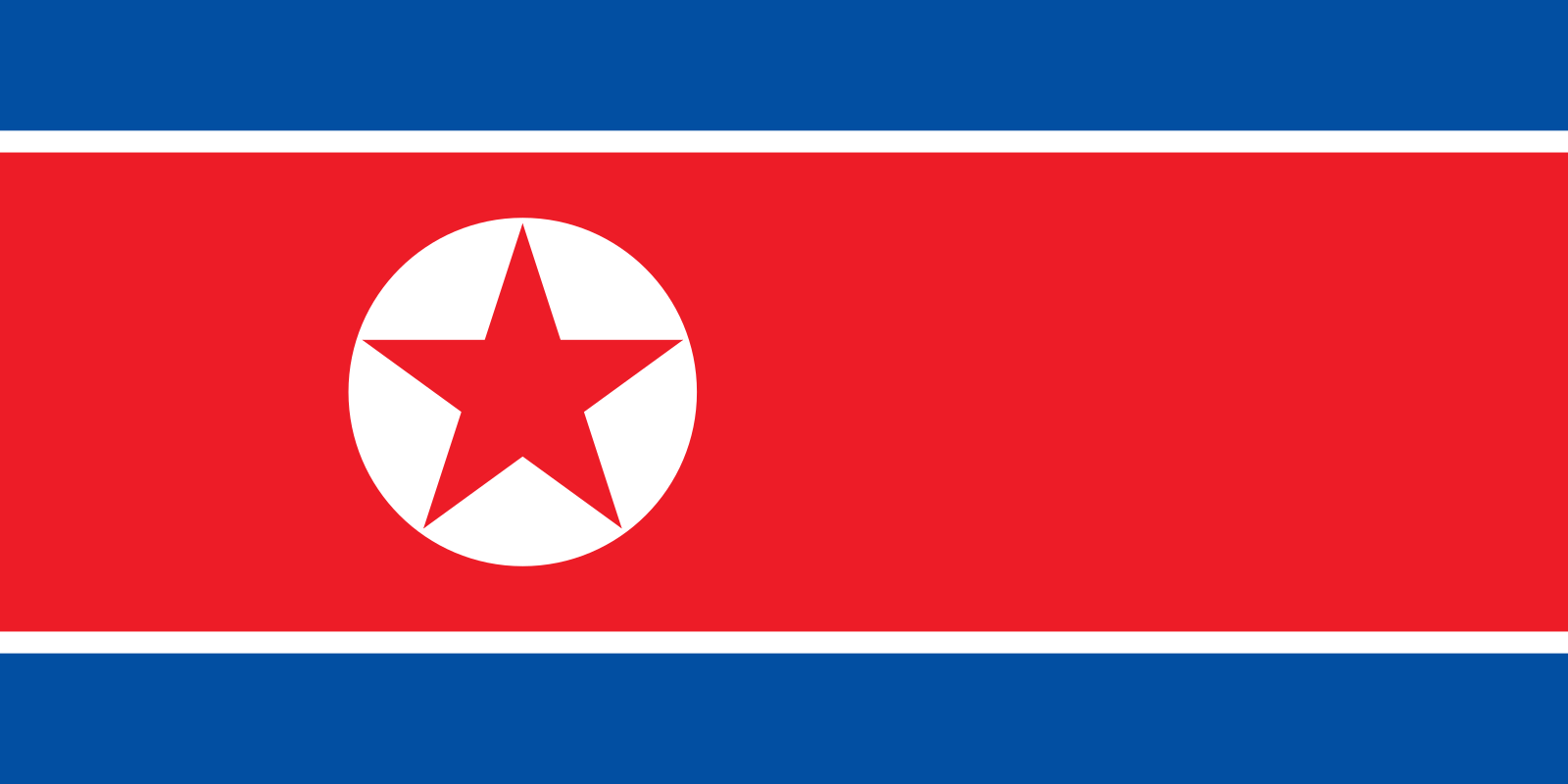
North Korea
Data updated Oct 10, 2026
Overall Score
18.2
Challenging
Avg. Rent (1BR)
$99
-94% vs US Avg
Safety Index
38.2
COL Index
15
Overall Score
18.2
ChallengingEstimated Cost
$743/mo
single person, incl. rent
North Korea isn't a relocation option for anyone reading this. There is no independent foreign residency path for retirees, remote workers, or digital nomads: no retirement visa, no passive-income visa, and no digital nomad visa. Foreigners who are present in the country are almost exclusively diplomats, aid workers, or tightly managed tour groups, not independent expats living on their own terms. If you're evaluating this as a place to actually move your life to, it fails at the first filter.
The cost-of-living figures you might see quoted look absurd on paper, numbers that would make this the cheapest country on any list. Treat those as statistically meaningless. Pricing data in North Korea comes from a closed, state-controlled economy with no functioning consumer market in the Western sense, no open currency exchange, and no way for a foreigner to rent an apartment on the open market the way you would in Hanoi or Tbilisi. The headline budget tells you nothing about what it would actually cost, or whether it's even possible, to live there independently.
The real friction is that "living there" isn't a choice you get to make unilaterally. Movement, housing, and daily routine for any foreigner present in the country are controlled and monitored by the state, not negotiated through a landlord or a visa office. The health system here is described as having no functioning insurance structure at all; it's entirely state-funded and under-resourced, which means a medical emergency is not something you can insure your way out of. The risk here is a different kind of risk than ordinary crime: it's the risk of a political and legal system with no outside appeal, no consular protection in any normal sense, and no exit guarantee if something goes wrong.
For a US citizen, the tax question is almost moot because there's no legal way to establish bona fide residency or meet the physical presence test there to claim the Foreign Earned Income Exclusion ($132,900 for 2026), and the FEIE is irrelevant if you can't legally live and work in the country in the first place. North Korea isn't in the structured tax treaty data here, and nothing in available sourcing supports claiming one exists. For practical purposes, there is no tax-planning angle to evaluate because there is no legal residency framework for an American to plan around.
North Korea vs. the East Asia average
Scores out of 10, shown as the gap between North Korea and the average of the 5 other countries in East Asia. 2 clear strengths, 6 clear gaps.
- Cost of Living+2.3
- Tax Friendliness+2.0
- English Speaking-1.2
- Residency Pathway-2.2
- Safety-4.6
- Public Transport-6.0
- Expat Community-6.4
- Healthcare-7.4
🚚 Moving to North Korea
Planning the move? Compare free quotes from international movers.
Get a free moving cost estimate for moving to North Korea. Takes 10 seconds.
How much are you shipping?
When are you moving?
Powered by Sirelo. Free quotes from international movers.
We may earn a commission if you request quotes through this tool.
Recommended Destinations in North Korea
Best for Retirees
Best for Geoarbitrage
Best for Remote Workers
- Capital
- Pyongyang
- Official Language
- Korean
- Time Zone
- UTC+09:00
- Region
- Asia
- Population
- 25,778,815
- Healthcare Index
- 19.8
- Climate Zones
- continental
View on Interactive Map
Explore data visually
🏙️ Top Cities in North Korea
Explore cost of living, walkability scores, and expat ratings for individual cities in North Korea.
CoL Index: 36
Est. Total: ~$540/mo
CoL Index: 28
Est. Total: ~$410/mo
How far does $1,500 go in North Korea?
With a monthly budget of $1,500, you can live comfortably in North Korea. After accounting for an average rent of $$99, you have approximately $1,402remaining for daily expenses.
Calculate your FIRE timeline with these costs →💰 Cost of Living in North Korea
Relative to New York City (NYC = 100). A lower number means it's cheaper.
Estimate the cost of shipping your belongings to North Korea →
See how North Korea's cost of living compares with Japan
🛒 Grocery & Family Costs
Family Costs
Can I afford to live in North Korea?
Comfortable (1.0×): balanced baseline lifestyle. Adjusts day-to-day costs only — rent is unaffected.
North Korea
You could save
2,266/mo
Monthly Costs
Attractiveness Scores
Based on national averages. City-level costs may vary. Browse cities in North Korea →
⚕️ Healthcare System
Our Top Pick for Nomads: SafetyWing
Flexible, subscription-based health cover for remote workers in North Korea.
Get Covered with SafetyWing →Looking for more options? Check Ekta.
An estimation of the overall quality of the health care system. Higher is better.
Quality & Affordability:
There is no functioning health insurance system; healthcare is state-funded.
Insurance Insights:
There is no functioning health insurance system; healthcare is state-funded.
See how North Korea's healthcare compares with Japan
🛂 Visa & Residency Pathways
🛂 Visa Services
Ready to apply for a North Korea visa?
Get help with your application — tourist, long-stay, and residency visas processed online.
General Overview
Process & Requirements:
North Korea (DPRK) does not have an immigration system or long-term residency pathways for foreign nationals. It is one of the most isolated and controlled countries in the world. Foreign presence is strictly limited to diplomats, a very small number of staff from international organizations like the UN, and highly controlled tourist groups (when travel is permitted). There are no provisions for independent travel, work, retirement, or investment for the average individual.
All foreign nationals in the country are under constant supervision, and their movements are heavily restricted. The concept of applying for residency is non-existent. The score of 1 reflects the complete absence of any accessible or predictable system.
Residency & Citizenship Notes:
There is no pathway to permanent residency or citizenship for foreign nationals in North Korea. The country's laws on nationality are based exclusively on descent and do not have provisions for naturalization of foreigners. The idea of an expat becoming a permanent resident or citizen is legally and practically impossible.
🛂 Visa Matcher
See which North Korea visas you qualify for
Answer 11 quick questions and get matched to the right visa for your situation.
Free · No signup required to see results
Detailed Visa Options
🧳 Tourist & Short-Stay Information
Extension Notes
Not applicable, as tourism is highly restricted and controlled. Source: N/A
General Visa Notes
US citizens are subject to a U.S. travel restriction which invalidates their passport for travel to, in, or through North Korea (DPRK) without a special validation from the Department of State. Obtaining this validation is rare. All approved travel must be through a state-sanctioned tour operator. Source: U.S. Department of State Travel Advisory.
🌴 Retirement / Passive Income Visa
This country does not have a dedicated retirement visa, but the following notes provide guidance on pathways for retirees.
Income Notes
North Korea (DPRK) does not have any provisions for foreign nationals to retire in the country. Tourism is highly restricted and long-term residency for such purposes is not possible.
Health Insurance Notes
North Korea (DPRK) does not have any provisions for foreign nationals to retire in the country. Any visitor is under the complete care of their host organization, which handles medical needs. Independent insurance is not a applicable concept. Source: General knowledge.
💻 Digital Nomad Visa
Income Notes
North Korea (DPRK) does not have a digital nomad visa. All travel is strictly controlled and must be done through state-approved tour operators. Independent travel, let alone remote work, is not permitted. Source: DPRK government websites and affiliated tour operators.
📈 Investor Visa
Investment Details
Investment Options & Notes
North Korea does not have an investor visa program open to the general public. All investments are state-controlled and do not confer residency rights. Source: N/A
Path to Citizenship
Many long-stay visas require proof of health insurance. Compare international health plans before you apply.
Compare health insuranceWe may earn a commission at no cost to you.
🛡️ Safety & Stability
An estimation of overall safety level. Higher is better.
An estimation of the overall level of crime. Lower is better.
World Bank political stability estimate, rescaled to 0-100. Higher is better.
Safety Notes:
Crime Rate: The 2025 Safety Index for North Korea is 38.2. North Korea is a closed society with limited information available.
Types of Crime: Information not available.
Kidnapping Risk: Unknown; information is limited.
🏦 Taxation & Finance
🏦 Tax Snapshot
FEIE Interaction
FTC Utility: none
No personal income tax exists in North Korea. There is no foreign tax credit available because no creditable taxes are paid. FEIE would be the relevant mechanism for any earned income, though the entire scenario is inapplicable given US passport restrictions and OFAC sanctions prohibiting US persons from residing or working in North Korea.
Presence Day Count Notes
The standard 330-day physical presence test technically applies for IRS purposes, but US passports are not valid for travel to North Korea without a special Treasury and State Department validation. US citizens present in North Korea would almost certainly not meet the bona fide residence test given the extraordinary legal constraints. Physical presence test remains the theoretical qualifying path.
FBAR Trigger Notes
North Korean financial institutions are blacklisted under OFAC sanctions. US persons are prohibited from transacting with DPRK entities under 31 CFR Part 510. Any account held at a North Korean bank by a US person would trigger FBAR reporting requirements but would itself constitute a sanctions violation. Effectively no legitimate financial account accessible to US persons.
401k/IRA Treatment
Pension Income
No personal income tax applies under the 1974 tax abolition. Foreign pension income would not be locally taxed.
Not Taxed LocallySocial Security
No US-DPRK tax treaty. No personal income tax. US Social Security benefits received by a US person notionally in North Korea would face no local tax, but the scenario is purely hypothetical given legal restrictions on US citizens entering or residing in North Korea.
Not Taxed LocallyRoth Distributions
No personal income tax system applies. Roth distributions would not be subject to local tax. Practical scenario is inapplicable given travel and sanctions restrictions.
Not Taxed LocallyUS 401k/IRA Distributions
No US-DPRK tax treaty exists. Personal income tax was abolished in 1974. US citizens are effectively barred from residing in North Korea under State Department Level 4 Do Not Travel advisory and passport restrictions. No local tax would apply to 401k or IRA distributions in the theoretical scenario of a US person present in the country.
Not Taxed LocallyCapital Gains Tax
North Korea does not operate a conventional tax system for individuals. The 1974 abolition of personal income tax was a state propaganda milestone. No capital gains tax framework exists for residents. Foreign enterprises operating under joint venture arrangements may face levies, but published rates are not independently verifiable. No treaty with the US exists.
North Korea officially abolished personal income tax in 1974 under the Tax Abolition Law. No capital gains tax applies to individuals. Foreign-invested enterprises in special economic zones such as Rason may be subject to profit remittance taxes, but independent verification of specific rates is not possible given the closed nature of the economy.
Dividend Tax Rate
No dividend tax applies to North Korean residents under the domestic system. For foreign investors in special economic zones, withholding on profit repatriation has been cited in North Korean foreign investment law at rates ranging from 10% to 20%, but independent verification is not possible. US persons are effectively prohibited from investment in North Korea under OFAC sanctions.
exempt
Rate: 0.0%
Domestic residents - no dividend tax under the post-1974 no-personal-tax framework.
withholding
Rate: 10.0%
Cited rate for foreign investors under North Korean foreign investment law in designated special economic zones. Not independently verifiable.
Tax Treaties Notes:
No US-North Korea relations. Taxation data unavailable.
Retiree Tax Benefits:
Retirement by foreigners is virtually non-existent due to political isolation. North Korea does not offer a retiree visa.
Cost Savings vs. U.S.:
Data unavailable. Not feasible for US retirees.
Pick between Form 2555 (Foreign Earned Income Exclusion) and Form 1116 (Foreign Tax Credit) with an expat tax service.
Get help with my expat taxesWe may earn a commission at no cost to you.
Recommended services for North Korea
Recommended Partner
Fidelity →See how North Korea's taxes compares with Japan
☀️ Climate & Environment
Climate Zones:
Our proprietary index for drinking water quality and sanitation. Higher is better.
Seasonal Variations:
North Korea experiences a continental climate with four distinct seasons. Winters are long and cold, while summers are short and warm with most of the annual precipitation occurring during this time.
😊 Quality of Life
Cultural Amenities:
Museums & Cultural Institutions
North Korea has several state-run museums, including the Korean Central History Museum in Pyongyang, showcasing the country's history and culture.
The Victorious Fatherland Liberation War Museum in Pyongyang offers exhibits on the Korean War from the North Korean perspective.
Performing Arts
North Korea has a state-controlled performing arts scene, with performances held during national holidays and events.
The Moranbong Band is a prominent all-female musical group in North Korea, known for their performances at state events.
Cultural Festivals
The Arirang Mass Games is a large-scale gymnastics and artistic performance held in Pyongyang, showcasing North Korean culture and ideology.
The Day of the Sun, celebrating the birth of Kim Il-sung, is marked with various cultural performances and events.
Culinary Culture
North Korean cuisine includes dishes like kimchi, bibimbap, and cold noodles.
The country's cuisine reflects its Korean heritage and available local ingredients.
🌐 Infrastructure & Connectivity
Our proprietary ranking of public transit accessibility and reliability.
Internet Reliability:
North Korea has extremely limited internet access with government-controlled infrastructure and restricted connectivity.
Speed & Quality: Internet access is restricted to government officials and select institutions; speeds and content are government-controlled.
Availability: No public internet access; connectivity is limited to government officials and select institutions.
Cost: Not applicable for general population due to restricted access.
Reliability for Remote Work: Not suitable for remote work due to restricted government-controlled internet access.
Transportation Network:
North Korea has a state-controlled transportation system with limited access for civilians and international isolation.
Roads: Road network exists but private car ownership is extremely limited.
Rail: Extensive rail network serving the country, primarily for state-approved transport.
Domestic Travel: Very limited domestic flights; most approved transport is by state-controlled trains and buses.
Recommended services for North Korea
Recommended Partner
Traveling Mailbox →Frequently Asked Questions about North Korea
Click any question to expand the answer.
📚 Related Reading
Share This Guide
North Korea's rules change. We'll tell you when.
Visa, tax, and cost updates for North Korea, before they catch you out. Free with RA Postcards.
By submitting your email address, you will receive a free subscription to RA Postcards and special offers from Rewire Abroad and our affiliates. You can unsubscribe at any time, and we encourage you to read more about our Privacy Policy.