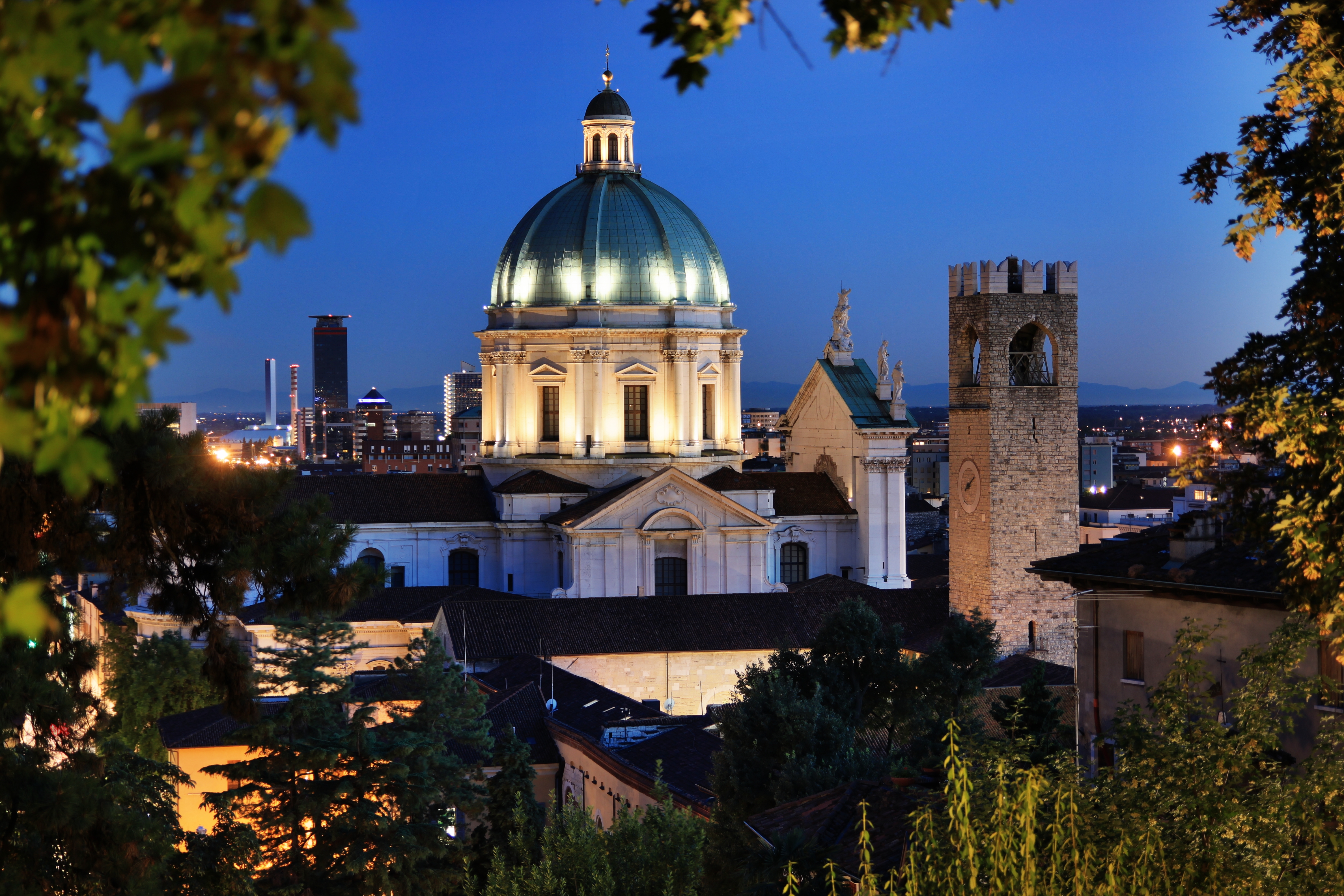
Brescia sits in northern Italy at 149 m above sea level, in the Europe/Rome timezone, with a subtropical climate that brings humid summers and cool, damp winters. The city holds about 196 thousand residents, and its compact core makes daily life easy to navigate on foot or by bus. Expats tend to settle in Viale Piave and the Center, where apartment blocks mix with cafes, markets, and tram lines. The Center puts you close to the Roman ruins, the castle on Cidneo hill, and the main squares, while Viale Piave offers a slightly quieter residential feel with quick access to the same amenities. English is common in tourist areas, and the expat community is large and active, which helps newcomers find social groups, language exchanges, and practical advice.
Renting a one-bedroom apartment in the city center runs $932/mo, while outside the center it drops to $755/mo. A three-bedroom in the center costs $1,894/mo, and outside the center it is $1,368/mo. Utilities add $328/mo, internet $31/mo, and a mobile phone plan $14/mo. A monthly public transport pass is $44/mo, and a gym membership is $42/mo. Eating out is affordable by Western European standards: an inexpensive restaurant meal is $22 per person, a mid-range three-course meal for two is $84, and a cappuccino is $3. Excluding rent, a single person spends about $1,155/mo, and a family of four spends about $4,043/mo. Budget, mid-range, and comfortable tiers for a single adult, rent included, come to $1,128/mo, $1,692/mo, and $2,121/mo. The average local net salary is $1,950/mo, and the cost of living index is 67/100 against New York City at 100, so a remote income or a dual-income household stretches further here than in many nearby cities.
Safety is a strong point: the safety index is 75/100 and the crime index is 25/100, with lower numbers meaning less crime. Day-to-day life feels calm, and central streets remain busy well into the evening. Healthcare quality is rated excellent, which matters for long-term residents who want reliable access to specialists and hospitals. Air quality sits at 75 on the index, where lower is better, so sensitive individuals may notice summer smog and winter inversion days. Average internet speed is 60 Mbps, enough for video calls, streaming, and most remote work, though heavier data users may want to check the connection at a specific address before signing a lease.
For longer stays, Italy offers the Italy Elective Residence Visa, which requires a minimum monthly income of $2,895/mo, and the Italy Digital Nomad Visa, which requires a minimum monthly income of $2,615/mo. The nearest airport is LIN, 9 km away, making weekend trips and international connections straightforward. With an overall expat score of 75/100, a digital nomad score of 77/100, a FIRE score of 75/100, and a retiree score of 73/100, Brescia suits remote workers, early retirees, and anyone who wants a mid-sized northern Italian city with lower costs than Milan, solid infrastructure, and a large, active expat community. It rewards people who value walkable streets, excellent healthcare, and a pace of life that stays manageable without feeling remote.