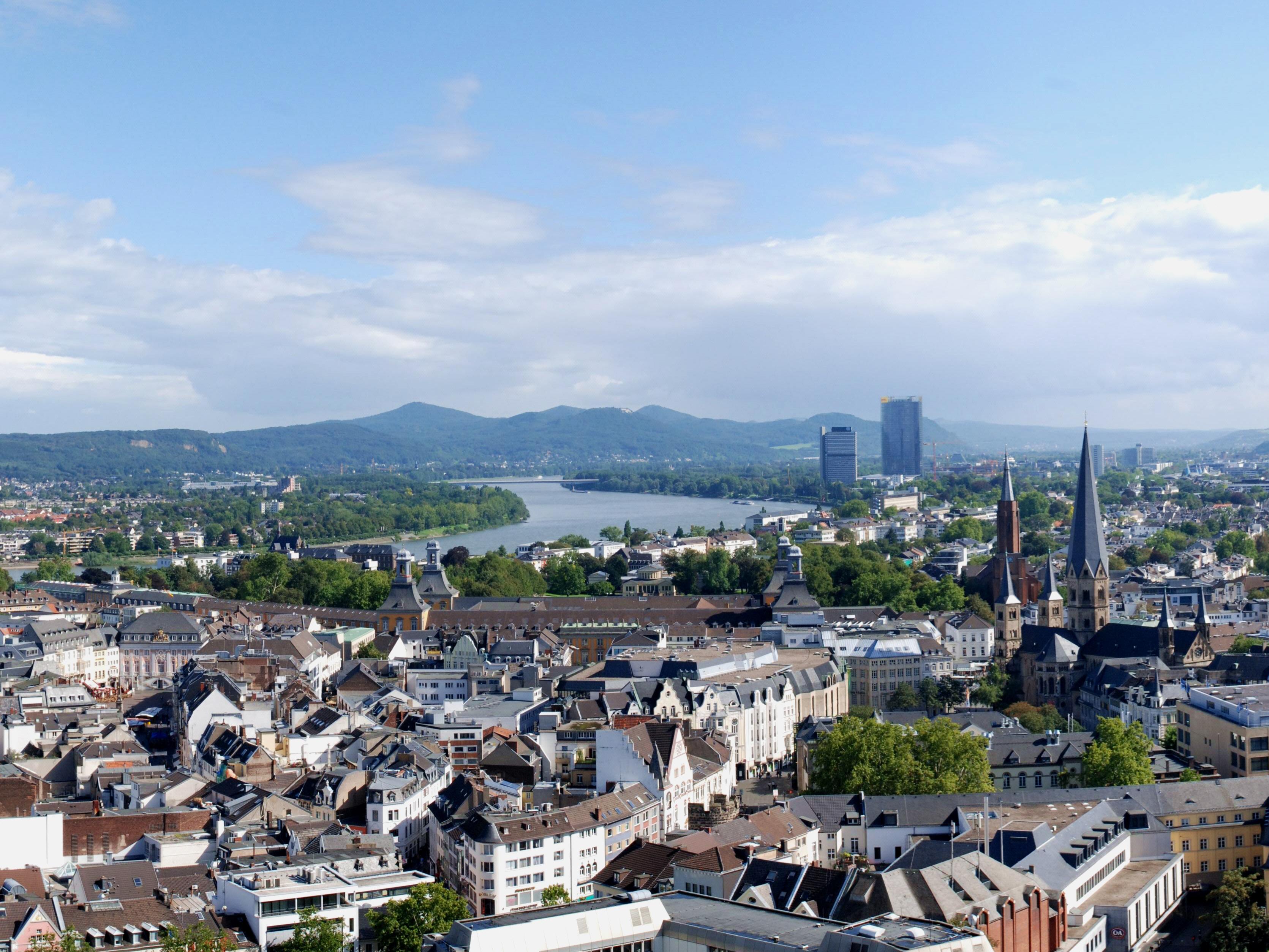
Bonn sits in western Germany on the banks of the Rhine, about 60 m above sea level in the Europe/Berlin timezone, with a temperate climate that brings mild summers and cool, damp winters. The city is home to roughly 336 thousand people, and its compact scale makes it easy to cross by bike, tram, or on foot. Expats tend to cluster in a few well-established areas. Venusberg draws those who want quiet, wooded surroundings close to the university hospital. Poppelsdorf appeals to academics and families who like a village feel with quick access to the center. Bad Godesberg, once the diplomatic quarter, remains popular for its larger apartments, international schools, and riverfront walks.
Living costs here sit well below the biggest European capitals. A one-bedroom apartment in the city center runs $1,055/mo, while the same outside the center drops to $915/mo. Three-bedroom places average $2,128/mo in the center and $1,633/mo outside it. Utilities add about $331/mo, internet $39/mo, and a mobile phone plan $25/mo. A monthly public transport pass costs $71/mo and a gym membership $44/mo. Everyday food is modest: an inexpensive restaurant meal is $18 per person, a mid-range three-course dinner for two is $78, and a cappuccino is $4. Excluding rent, a single person spends around $1,175/mo and a family of four around $4,121/mo. For a single adult including rent, a budget tier totals $1,850/mo, a mid-range tier $3,000/mo, and a comfortable tier $4,500/mo. Average monthly net salary locally is $3,500/mo, and the cost of living index stands at 69/100 against New York City at 100.
Safety is a strong point. The safety index is 90/100 and the crime index is 10/100, so violent crime is rare and petty theft is the main concern in busy areas. Air quality is good, with an index of 40 where lower is better. Healthcare quality is rated excellent, and the city's university hospital anchors a dense network of clinics and specialists. Internet averages 110 Mbps, fast enough for remote work, streaming, and video calls without strain.
For longer stays, Germany offers the §7 Abs. 1 S. 3 AufenthG retirement visa program, which requires a minimum monthly income of $1,200/mo, and the Freelancer Residence Permit under Section 21 of the German Residence Act for independent professionals. The nearest airport is CGN, 14 km away. English is common in tourist areas, and the expat community is large and active. Bonn scores 79/100 overall for expats, 81/100 for digital nomads, 74/100 on FIRE, and 73/100 for retirees. It suits remote workers, academics, researchers, and retirees who want a mid-sized Rhine city with strong public services, moderate rents, and quick connections to the rest of Europe.