Earning from Anywhere: How to Build a Location-Independent Income Stream to Supercharge Your FIRE Goals

Turn skills you already have into portable income — and use GeoArbitrage to reach financial independence faster than you ever thought possible.
So, you’ve been tracking your spending with surgical precision. You brew coffee at home, avoid impulse buys like they’re landmines, and you’ve got a spreadsheet that could make a CPA weep with joy. In other words, you’ve nailed the “save more” part of the FIRE (Financial Independence, Retire Early) equation.test
But here’s the problem: cutting expenses can only take you so far. What if, instead of squeezing your budget tighter, you flipped the script and earned differently?
Specifically: what if you started earning remotely, in a strong currency, while living in a low-cost country? Suddenly, your path to FIRE isn’t just shorter—it’s turbocharged.
The opportunity is real: remote income + geographic arbitrage = an accelerator few FIRE folks fully tap into. This guide shows you how to build a portable income stream that lets you earn from anywhere and escape the 9-to-5 hamster wheel on your own terms.
Spoiler: you don’t need to launch a million-dollar startup. You just need to earn enough—and spend wisely.
The Problem Most FIRE Seekers Don't See Coming
Walk into any FIRE forum and you'll find people obsessing over whether to invest in VTSAX or VTI, debating the 4% rule, and calculating exactly how much avocado toast is sabotaging their retirement dreams. But scroll through those same forums and notice what's missing: anyone talking about where they're planning to spend those retirement years.
Here's the thing about traditional FIRE advice — it assumes you'll be retiring in the same high-cost environment where you're currently grinding. San Francisco salaries with San Francisco expenses. London income with London rent. That math works, eventually, but it's the scenic route to financial independence.
The FIRE community has discovered something powerful: you can live well on less money. But they've only applied this principle to extreme frugality within expensive markets. What they haven't fully embraced is applying that same principle geographically. Why optimize your spending down to $40,000 a year in Seattle when you could maintain the same quality of life for $15,000 a year in Medellín?
The missing piece isn't just geographical arbitrage — it's building the income streams that make geographical arbitrage possible. Because here's what no one tells you about moving abroad: your expenses might drop by 70%, but your income often drops to zero if you haven't planned ahead.
Why Remote Income + Geoarbitrage = FIRE on Steroids
Let’s break it down: earning in a strong currency (like USD, EUR, GBP) while spending in a weaker one (like the Mexican peso or Thai baht) gives your income a built-in boost. This is the magic of geoarbitrage—a fancy word for “live cheap in paradise.”
Meet Sarah, our hypothetical but realistic FIRE seeker. She's 28, earns $65,000 in Denver, and saves $20,000 annually after expenses. At this rate, she'll hit her FIRE number of $1 million in about 22 years, retiring at 50.
Now meet Global Sarah, same person with a plot twist. She builds location-independent income streams that generate $45,000 annually and moves to Mexico City, where her monthly expenses drop to $1,200. Her annual spending: $14,400. Her annual savings: $30,600.
The math gets wild here. Global Sarah reaches $1 million in 15 years instead of 22. That's seven years of her life back — seven years she can spend exploring ancient temples in Cambodia instead of sitting in Denver traffic.
But wait, it gets better. Global Sarah doesn't even need $1 million to retire early abroad. With her reduced expenses, she only needs $360,000 to generate her required $14,400 annually using the 4% rule. At her savings rate, she hits this target in just 10 years.
Same person. Same skills. Different location strategy. The difference: 12 years.
This isn't about being a cheapskate or living like a backpacker forever. It's about recognizing that $1,200 in Mexico City buys you a lifestyle that would cost $3,500 in Denver. You're not sacrificing quality of life — you're optimizing the hell out of it.
Your Realistic Options for Location-Independent Income
The good news: you don't need to invent the next Uber or become a crypto day trader to build portable income. The even better news: you probably already have skills that translate directly into remote earnings. Let's break down your realistic options, complete with the honest pros and cons.
Freelancing
This is the fastest path from "I need remote income" to "I have remote income." Freelancing lets you package existing skills into billable services, often starting within weeks of deciding to go remote.
The freelancing landscape is broader than most people realize. Sure, writing and graphic design are obvious choices, but consider virtual assistance, social media management, bookkeeping, translation, online tutoring, or even specialized consulting in your current field.
The secret sauce isn't having the most impressive skills — it's being reliable and easy to work with. Clients will pay premium rates for freelancers who respond to emails promptly, meet deadlines, and don't create drama. Revolutionary concept, apparently.
Platforms like Upwork and Fiverr get a bad rap for race-to-the-bottom pricing, but they're excellent for building initial client relationships and testimonials. Once you've proven your worth, many clients will happily move off-platform and pay higher rates to avoid platform fees.
Remote Employment
If freelancing feels too entrepreneurial, remote employment offers the traditional benefits of a job — steady paycheck, health insurance, paid time off — without the traditional constraint of showing up to an office.
The remote job market has exploded post-pandemic. Companies that once insisted butts-in-seats were essential for productivity now realize that talent doesn't require a specific zip code. Job boards like FlexJobs, Remote OK, and AngelList's remote section are goldmines for legitimate opportunities.
Pro tip: Target companies that are "remote-first" rather than "remote-friendly." Remote-first companies built their operations around distributed teams, while remote-friendly companies often treat remote workers as second-class citizens who miss out on office politics and water cooler promotions.
Some companies are particularly visa-friendly for international remote workers. Look for organizations with distributed teams across multiple countries — they've already figured out the legal and tax complexities of international employment.
Digital Products & Microbusinesses
This is the long game that can pay the biggest dividends. Instead of trading time for money, you're creating assets that can generate income while you sleep (or while you're exploring temples in Angkor Wat).
Digital products run the gamut from online courses and ebooks to software-as-a-service tools and subscription communities. The key is starting small and solving specific problems for specific people.
Consider dropservicing — essentially running a service business where you handle client relationships while outsourcing the actual work to specialists. You might offer website design services but partner with developers in lower-cost markets to deliver the work. Your role becomes project management and client communication, both highly location-independent activities.
Tools like ConvertKit for email marketing, Canva Pro for visual assets, and Namecheap for domains and hosting make it easier than ever to test business ideas without massive upfront investment.
How to Get Started From Scratch
The biggest barrier to building location-independent income isn't skill or capital — it's decision paralysis. People spend months researching the perfect strategy instead of spending weeks testing an imperfect one. Here's your step-by-step action plan:
Step 1: Identify a monetizable skill or service Start with what you already know. Administrative skills translate to virtual assistance. Communication skills become content writing or social media management. Technical knowledge becomes consulting or online tutoring. You don't need to be world-class at something to get paid for it — you just need to be better than someone who's never done it before.
Step 2: Test demand without building a business Before creating websites or business cards, validate that people will actually pay for your service. Offer to help friends or colleagues with projects. Post in freelancing groups or local Facebook communities. Apply for a few gigs on Upwork, even if you're not sure you're qualified. The goal isn't to win every project — it's to understand what clients actually want and what they're willing to pay.
Step 3: Set up simple tools for serious business Once you've confirmed demand, invest in basic infrastructure. Set up invoicing through tools like Wave or FreshBooks. Create a simple landing page using Squarespace or even a well-crafted LinkedIn profile. Open a separate bank account for business income. You're not building a corporation — you're creating enough legitimacy to get paid professionally.
Step 4: Optimize for location arbitrage As your income stabilizes, start researching target destinations where your earnings will stretch furthest. Use tools like Numbeo to compare living costs between cities. Consider factors beyond just expense ratios — internet quality, time zones relative to your clients, visa requirements, and overall quality of life.
The FIRE Calculator can help you model how different locations impact your timeline to financial independence. A $2,000 monthly income goes much further in Chiang Mai than Chicago.
Common Challenges (And How to Beat Them)
Every aspiring location-independent worker faces the same mental obstacles. Here's how to bulldoze through them:
"I don't have a high-income skill" This is code for "I don't think my current skills are valuable enough." But here's reality: someone, somewhere, is willing to pay for almost any skill. Data entry, customer service, basic graphic design, proofreading, appointment scheduling — these aren't glamorous, but they're all legitimate services that businesses need.
You don't need to be a software engineer earning $150K remotely. You need to earn enough to cover your expenses in a lower-cost location. For many destinations, that magic number is surprisingly low.
"I'm overwhelmed by all the options" Analysis paralysis is the killer of remote income dreams. Instead of researching every possible strategy, pick one that aligns with your current skills and commit to testing it for 30 days. Not 30 days of research — 30 days of actual implementation.
If freelance writing interests you, spend those 30 days applying to writing gigs and creating sample articles. If remote employment appeals to you, spend those 30 days customizing applications and networking in relevant communities. Progress beats perfection every time.
"What if I fail and waste my time?" Let's define failure realistically. You're not buying a house or starting a manufacturing company. You're testing whether you can earn money remotely. The financial risk is minimal, and the learning value is massive.
😰 Common Fear | 💭 What You Think | ✅ Reality & Solution | 🎯 Action Step |
|---|---|---|---|
🚫 "I don't have high-income skills" | I need to be a software engineer earning $150K+ to work remotely | Someone will pay for ANY skill You need "enough" not "amazing" Data entry, proofreading, VA work all count $2K/month goes far in many countries | List 3 skills you use at work daily. Research what people charge for those services on Upwork. |
🤯 "I'm overwhelmed by all the options" | I need to research every possibility before starting anything | Analysis paralysis kills dreams Pick ONE strategy for 30 days Progress beats perfection every time You can pivot after testing | Choose freelancing, remote job search, OR digital products. Commit to 30 days of ACTION, not research. |
⚠️ "What if I fail and waste my time?" | This is risky and I might lose everything | Minimal financial risk (no inventory/loans) Massive learning value even if you "fail" Traditional employment isn't risk-free either Knowledge from attempt #1 makes attempt #2 better | Define "failure" realistically. Set a small test budget ($100-500) and timeline (30-60 days). |
🌍 "I don't know about taxes/visas/legal stuff" | International work is too complicated for regular people | Millions of people work remotely internationally Start domestically, expand later Resources exist for every common situation Many countries welcome remote workers | Research one target country's digital nomad visa requirements. Join expat Facebook groups for that location. |
💰 "I can't afford to quit my job to try this" | I need to choose between stability and remote wor | Build remote income WHILE employed Test and validate before making big moves Many remote jobs offer same security as local ones GeoArbitrage works with lower income too | Spend 1 hour daily for 30 days building remote income streams. Don't quit anything yet. |
Even if your first attempt doesn't generate significant income, you'll understand the remote work landscape better than 95% of people dreaming about digital nomadism. That knowledge positions you for success on attempt number two.
Plus, traditional employment isn't exactly risk-free either. Companies downsize, industries change, and commutes get longer. Building location-independent income streams is actually risk mitigation — you're diversifying beyond the single point of failure that is local employment.
Real-World Examples
Let's look at two realistic examples of people who built location-independent income and used GeoArbitrage to supercharge their FIRE timelines.
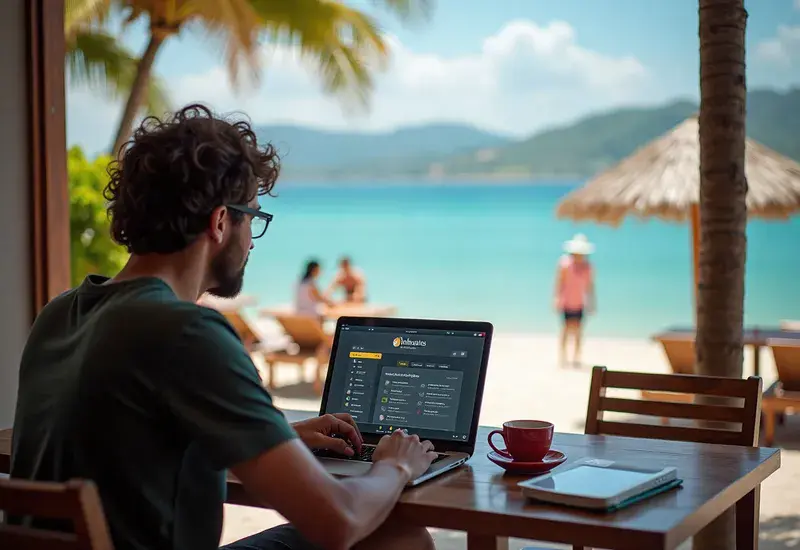
Sophie's Story: From HR Assistant to Freelance Ghostwriter
Sophie worked in HR for a mid-sized company in Portland, earning $42,000 annually. She was good at internal communications — writing company newsletters, policy updates, and training materials — but never considered this a monetizable skill.
When her company downsized, Sophie decided to test freelance writing instead of immediately job hunting. She created profiles on Upwork and Fiverr, offering blog writing and content creation services. Her first month, she earned $320. Her third month, $1,100. By month six, she had regular clients paying $1,800 monthly for approximately 20 hours of work per week.
Sophie moved to Mexico City, where her monthly expenses dropped to $1,200 including rent for a beautiful apartment in Roma Norte. Her $1,800 freelance income left her $600 monthly surplus — not amazing by Portland standards, but sufficient for her simplified lifestyle.
More importantly, Sophie's reduced expenses meant she only needed $360,000 to maintain her lifestyle indefinitely using the 4% rule. At her previous savings rate in Portland, this would have taken 18 years. With her new income and expenses, she reaches FIRE in just 8 years.
Ready to Rewire your Life?
Sign up to receive updates and insights.
By submitting your email address, you will receive a free subscription to RA Postcards and special offers from Rewire Abroad and our affiliates. You can unsubscribe at any time, and we encourage you to read more about our Privacy Policy.
Daniel's Template Empire
Daniel was a project manager who became obsessed with Notion during the pandemic. He built elaborate systems for personal productivity and started sharing templates with colleagues. When people kept asking for copies, he realized he'd stumbled onto something.
Daniel created a collection of Notion templates for small business owners and freelancers — project trackers, client management systems, content calendars. He sold them through Gumroad for $15-50 each, spending evenings and weekends building templates and writing marketing content.
His template business started earning $500 monthly, then $1,200, eventually stabilizing around $2,800 monthly with minimal ongoing maintenance. Daniel negotiated remote work with his employer and moved to Bali, where his living expenses average $1,000 monthly.
Here's his current financial picture:
Income Source | Monthly Amount |
|---|---|
Remote Salary | $4,200 |
Template Sales | $2,800 |
Total Income | $7,000 |
Living Expenses (Bali) | $1,000 |
Monthly Savings | $6,000 |
At this savings rate, Daniel reaches his FIRE target of $1.5 million in just 12 years — compared to 28 years if he'd stayed in his original market with traditional employment.
Want more inspiration? Read our guide on the Rewire Slowmad FIRE Lifestyle.
Frequently Asked Questions: Geoarbitrage + Remote Income for FIRE
Click any question to expand the answer.
Takeaways
Building location-independent income isn't about becoming a digital nomad influencer or scaling to seven figures. It's about creating enough portable earnings to unlock geographical arbitrage and accelerate your path to financial independence.
The key insights from successful location-independent FIRE seekers:
You don't need to scale big — you need to earn enough. A $40,000 remote income that would barely cover rent in San Francisco can fund a comfortable lifestyle in dozens of international destinations. Focus on reaching "enough" before optimizing for "more."
Geoarbitrage multiplies even modest income. The difference between earning $50,000 in Denver versus $35,000 in Medellín isn't just the $15,000 salary gap — it's the lifestyle and savings rate transformation that comes from lower living costs.
Proof of concept is more valuable than perfection. Your first remote income stream doesn't need to be your forever career. It needs to prove that you can earn money without being tethered to a specific location. That proof of concept opens doors to bigger opportunities and bolder geographical moves.
The path from traditional employment to location-independent FIRE isn't complicated, but it does require action over analysis. Start with skills you already have, test demand quickly, and optimize for progress over perfection.
Your FIRE timeline is waiting for you to think beyond traditional strategies. The question isn't whether you can build location-independent income — it's whether you're ready to stop treating geography as a fixed constraint in your financial planning.
Ready to take the first step? Whether you’re freelancing from a beach in Portugal or building digital products in Bali, the first $1K in location-independent income can unlock a radically different future. Start where you are—and let geoarbitrage do the rest.

Adonis Villanueva
Adonis Villanueva is the founder of RewireAbroad, where he combines technology, analytics, and global mobility research to help readers make smarter decisions about living abroad. His work centers on geoarbitrage, financial independence, visas, taxes, and long-term relocation planning.
Rewire Abroad
From Tech Layoff to Early Retirement: The 18-Month Abroad Acceleration Plan
Learn how one tech worker turned job loss into early retirement by relocating smart, cutting costs, and reclaiming freedom—without waiting for 65.

Your Money Goes Further Somewhere Else: The Complete Guide to Retiring Abroad in 2026
Retire abroad in 2026 with real visa income thresholds, cost data, healthcare strategies, and tax rules — the complete guide for American retirees.

Achieve FIRE Faster: 7 Proven Steps & Strategies to Early Financial Independence
Discover 7 actionable tips and strategies to accelerate your journey to financial independence, plus two bonus steps and proven resources.

Unlock Global Freedom: Your Guide to Digital Nomad Visas (Even Without a 9-to-5)
Unlock global living! Learn how Digital Nomad Visas offer freedom for Americans, even with freelance or passive income. Requirements & top countries.