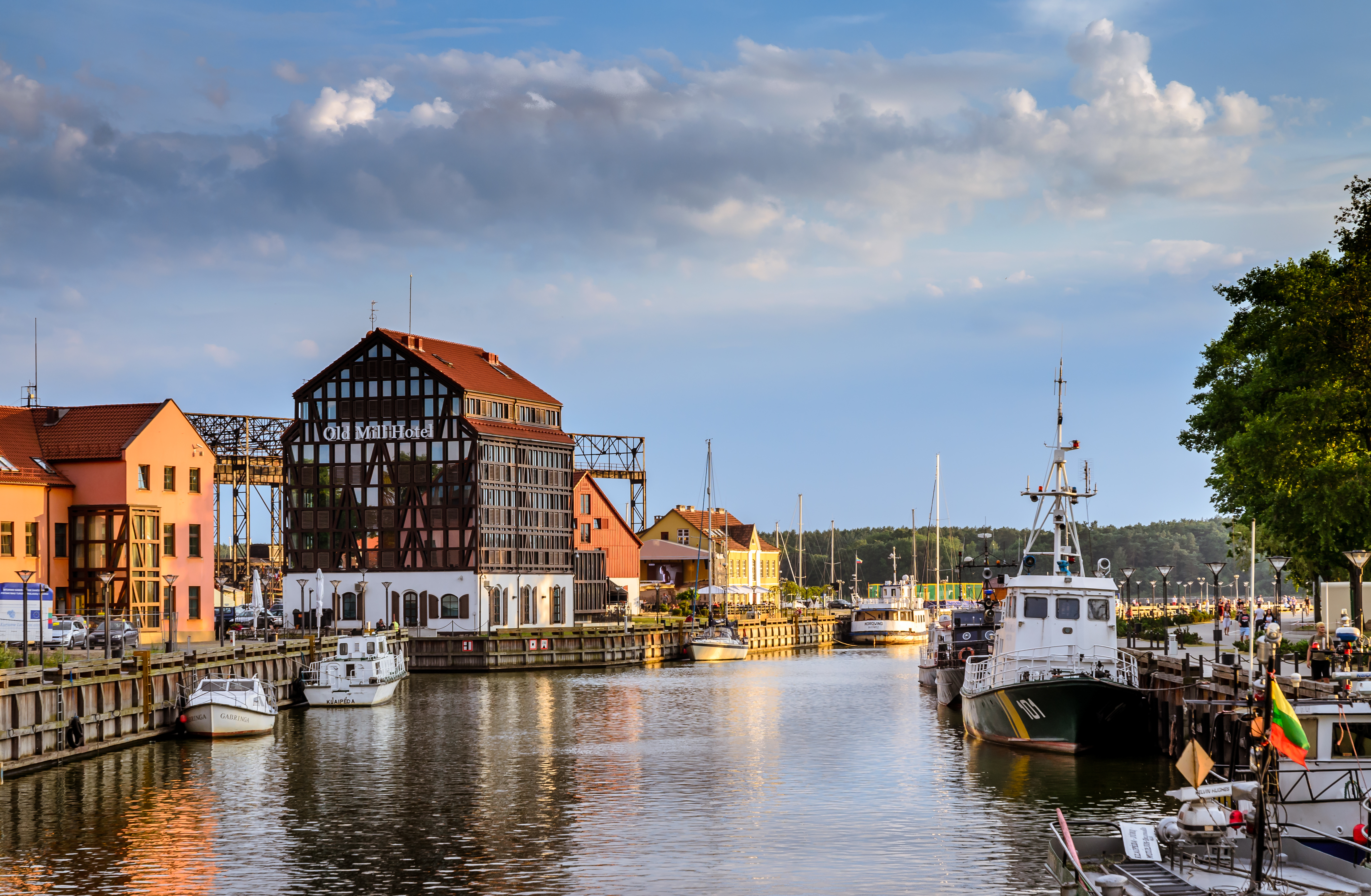
Klaipeda sits on Lithuania's Baltic coast, a port city of 152 thousand people built at just 5 m above sea level in the Europe/Vilnius timezone. Its maritime-influenced climate brings mild summers and high humidity, so summers feel softer than the continental interior while winters stay damp and gray rather than brutally cold. Expats tend to settle in two areas: Melnrage, the seaside district with dunes and a slower pace, and the Old Town, where half-timbered facades, cobbled lanes, and ferry links to the Curonian Spit keep daily life walkable. The city is compact enough that either choice puts you within reach of the water, the port, and the small but steady international crowd that calls this stretch of coast home.
Living costs here are modest by Western European standards, and the rent gap between the center and the edges is real. A one-bedroom apartment in the city center runs $582/mo, while the same outside the center drops to $370/mo. Three-bedroom units follow the same pattern: $958/mo centrally and $676/mo farther out. Utilities add about $204/mo, internet $14/mo, and a mobile phone plan $15/mo. A monthly public transport pass costs $32/mo and a gym membership $39/mo. Eating out stays affordable, with an inexpensive restaurant meal at $12 per person, a mid-range three-course dinner for two at $50, and a cappuccino at $3. Numbeo puts single-person monthly costs excluding rent at $750/mo and a family of four at $2,625/mo, while the average local net salary is $1,536/mo. The overall cost of living index sits at 44/100 against New York City at 100. Budget-tier single adults can manage on $622/mo with rent included, mid-range on $933/mo, and comfortable on $1,286/mo.
Safety is one of Klaipeda's strongest selling points. The safety index reads 83/100 and the crime index just 17/100, where lower is safer, so walking home after dark in the Old Town or along the coast is not the gamble it can be in larger European ports. Air quality is good, with an index of 32 where lower is better, helped by Baltic breezes and the absence of heavy industrial smog. Healthcare quality is rated Good, and English proficiency is common in tourist areas, which smooths the first weeks of settling in. The expat community is small, so newcomers often build their social circle through work, language exchanges, or the seaside neighborhoods rather than through a large established network.
For longer stays, Lithuania Digital Nomad Visa requires a minimum monthly income of $1,581/mo, which sits above the local average net salary and makes remote work the practical route for most foreign residents. The nearest airport is PLQ, 33 km away, keeping international connections within a short drive. Internet averages 55 Mbps, enough for video calls and remote work without strain. The city scores 81/100 overall for expats and 81/100 on the FIRE measure, 67/100 for retirees, and 70/100 for digital nomads. That mix suits remote workers, early retirees, and budget-conscious movers who want a walkable Baltic port with low rents, strong safety, and a quiet international scene rather than a crowded one.