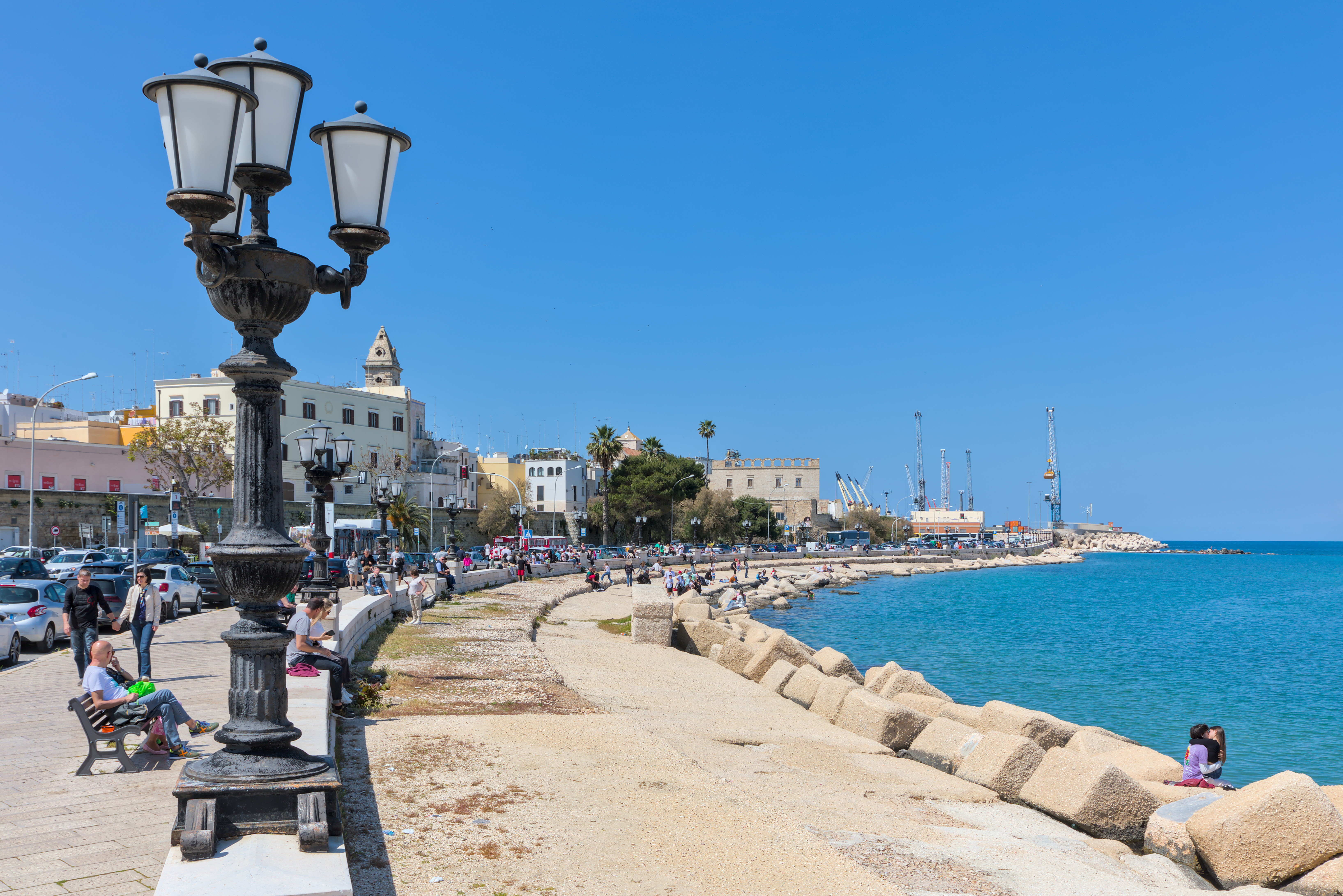
Bari sits on the Adriatic coast of southern Italy, a port city of 315 thousand people built just 5 m above sea level in the Europe/Rome timezone. Its climate is arid, which means long, dry summers and mild winters rather than the humid heat some visitors expect from the Mediterranean south. Expats tend to settle in two neighborhoods: Murat, the orderly grid near the old town and the sea, and Poggiofranco, a more residential district with wider streets and apartment blocks. The expat community here is medium in size, and English is common in tourist areas, so daily errands are manageable while you learn Italian.
Rents are the first thing most newcomers check, and Bari rewards them. A 1-bedroom apartment in the city center runs $896/mo, while the same outside the center drops to $641/mo. Families or sharers pay $1,608/mo for a 3-bedroom in the center or $1,109/mo outside it. Beyond rent, a single person spends about $900/mo, and a family of four about $3,203/mo. Utilities come to $210/mo, internet $30/mo, and a mobile phone plan $11/mo. A monthly public transport pass costs $39/mo and a gym membership $47/mo. Eating out is affordable: an inexpensive restaurant meal is $17 per person, a mid-range three-course meal for two is $67, and a cappuccino is $2. The overall cost of living index is 54/100 against New York City at 100. The catch is local pay: average monthly net salary is $1,892/mo, so a single adult on a budget tier spends $888/mo, mid-range $1,360/mo, and comfortable $1,800/mo.
Safety is a genuine selling point. The safety index is 70/100 and the crime index is 30/100, where lower is safer, so walking home at night is not the worry it can be in larger European cities. Air quality sits at 55 on the index, where lower is better, a middling score that reflects the port and traffic rather than heavy industry. Healthcare quality is rated good, and the city's compact size means most appointments and pharmacies are within easy reach. Average internet speed is 41 Mbps, workable for remote calls and streaming, though not the fastest you will find in Europe.
For longer stays, Italy offers the Italy Elective Residence Visa, which requires a minimum monthly income of $2,895/mo, and the Italy Digital Nomad Visa, which requires $2,615/mo. Both thresholds sit above the local average net salary, so they favor remote workers and retirees with outside income. The nearest airport is BRI, 7 km away, making arrivals and weekend trips simple. Bari scores 72/100 overall for expats, 74/100 on FIRE, 63/100 for retirees, and 70/100 for digital nomads. It suits remote workers, early retirees, and anyone who wants a walkable southern Italian port city where a comfortable single life costs $1,800/mo and the sea is never far away.