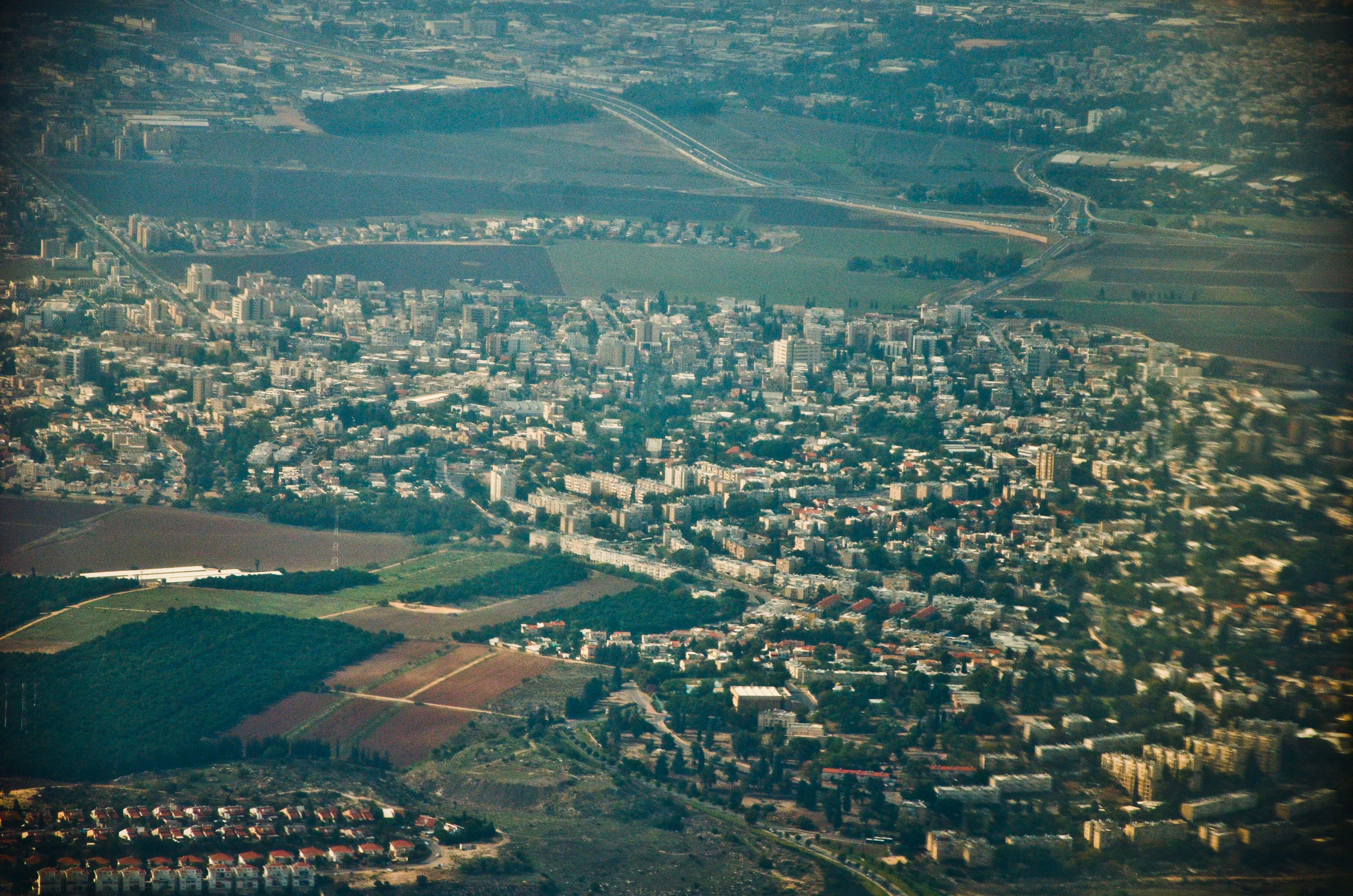
Kiryat Ata sits in Israel's northern coastal plain, about 30 m above sea level in the Asia/Jerusalem timezone, with a Mediterranean climate that brings hot, dry summers and mild, rainy winters. The city is home to roughly 62 thousand people, and its compact size keeps daily life manageable. Expats who settle here tend to gravitate toward Givat Tal, the neighborhood most often chosen by newcomers. The expat community itself is small, so the social scene is more local than international, and English is common in tourist areas rather than everywhere. For those who want a quieter base in the north, that trade-off is part of the appeal.
Rents are moderate by Israeli standards. A one-bedroom apartment in the city center runs $846/mo, while the same outside the center drops to $694/mo. Three-bedroom units go for $1,183/mo in the center and $1,004/mo outside it. Beyond rent, a single person spends about $1,150/mo, and a family of four spends around $4,050/mo. Utilities average $261/mo, internet $36/mo, and a mobile plan $12/mo. A monthly public transport pass costs $116/mo and a gym membership $59/mo. Eating out means about $26 for an inexpensive restaurant meal per person, $91 for a mid-range three-course meal for two, and $5 for a cappuccino. The average monthly net salary locally is $2,821/mo, and the cost of living index sits at 75/100 against New York City at 100. Budget, mid-range, and comfortable tiers for a single adult come to $1,122/mo, $1,712/mo, and $2,149/mo respectively.
Safety is a strong point. The safety index is 76/100 and the crime index is 24/100, with lower crime numbers meaning a safer environment. Healthcare quality is rated good, which matters for residents who want reliable care without traveling far. Air quality sits at 52 on the index, where lower is better, so the air is acceptable though not pristine. Overall, the city scores 56/100 for expats, 65/100 for FIRE, 63/100 for retirees, and 66/100 for digital nomads. Average internet speed is 60 Mbps, enough for remote work, streaming, and everyday connectivity.
Visas follow Israel's standard immigration channels, and the nearest airport is HFA, just 5 km away, which makes arrivals and departures unusually quick. The city suits budget-conscious renters, remote workers who value a low-key setting, and retirees drawn to the safety and healthcare ratings. It also fits savers chasing the FIRE score of 65/100 and digital nomads who can work from anywhere with 60 Mbps service. Families and singles alike will find the cost structure workable, especially outside the center, where a one-bedroom at $694/mo or a three-bedroom at $1,004/mo leaves room in the budget for the $1,150/mo in non-rent costs a single person typically faces.