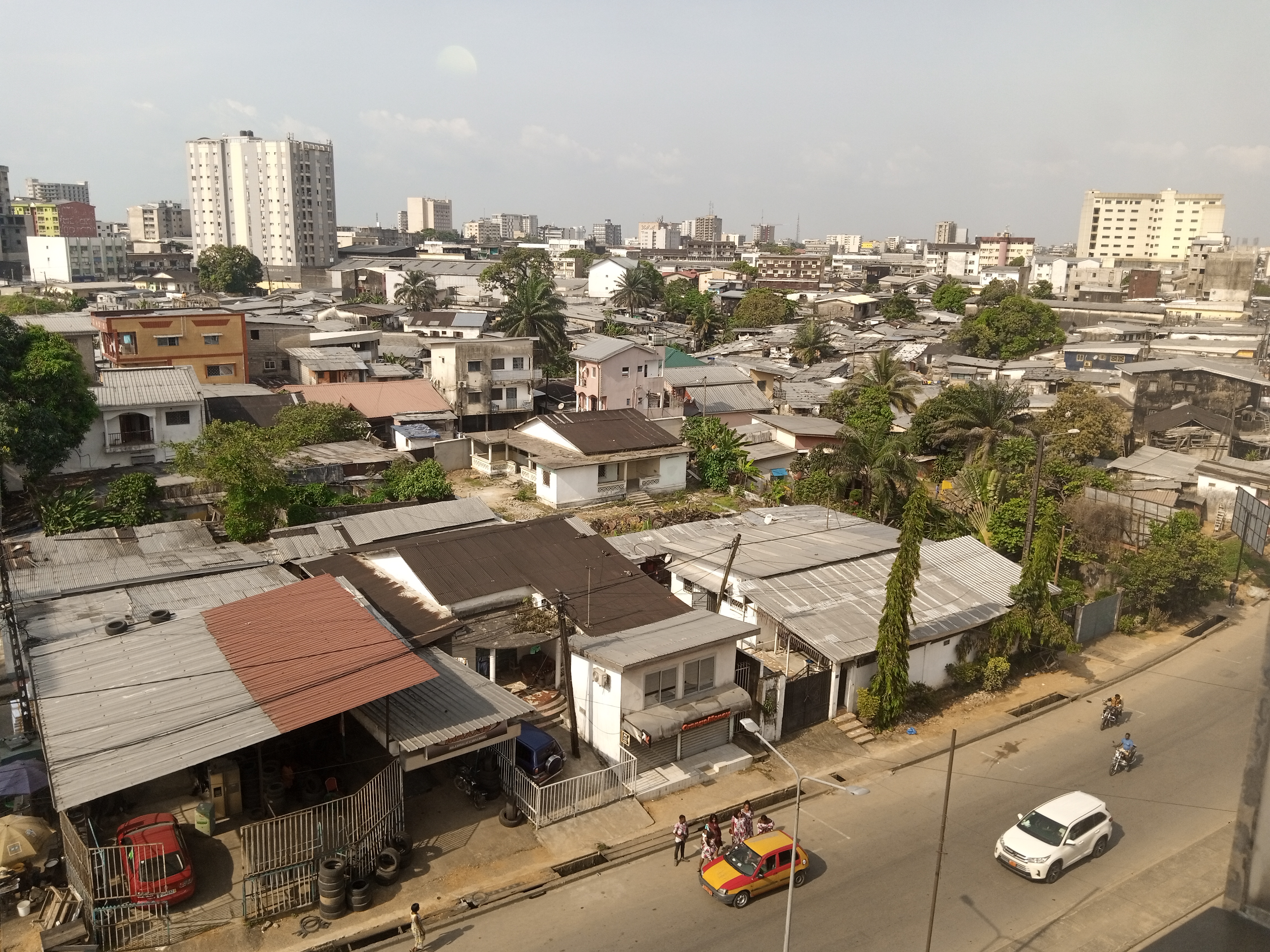
Douala sits on Cameroon's coastal plain at just 13 m above sea level, a tropical city of 1.5 million where heat and humidity shape daily life. The timezone is Africa/Douala. Expats tend to settle in Bonapriso and Akwa, two neighborhoods that offer a mix of residential calm and urban convenience. The nearest airport is DLA, only 4 km away, making arrivals and departures unusually quick for a city of this size.
Living costs depend heavily on where you live. A one-bedroom apartment in the city centre runs $560/mo, while outside the centre it drops to $319/mo. Three-bedroom units range from $1,325/mo in the centre to $541/mo outside. Monthly utilities average $163/mo, internet $176/mo, and a mobile phone plan $26/mo. A public transport pass costs $17/mo and a gym membership $41/mo. An inexpensive restaurant meal is $4 per person, a cappuccino $2, and a mid-range three-course meal for two $119. Excluding rent, a single person spends about $620/mo and a family of four $1,850/mo. Budget, mid-range, and comfortable tiers for a single adult, rent included, come to $748/mo, $1,010/mo, and $1,362/mo respectively. Against an average monthly net salary of $225/mo, the cost of living index of 48/100 (NYC = 100) shows how far local wages and expat budgets diverge.
Safety requires attention. The safety index is 40/100 and the crime index is 62/100, so street smarts matter, especially after dark. Healthcare quality is rated fair, which means serious cases may require evacuation or travel to better-equipped facilities. Air quality index stands at 68, a moderate concern for those with respiratory sensitivities. The expat community is small, and English proficiency is limited, so French or Douala language basics help enormously in daily interactions.
Visa requirements vary by nationality, and no single program fits all. Getting there is straightforward via DLA, 4 km from the city. With an overall expat score of 68/100, a FIRE score of 70/100, a retiree score of 50/100, and a digital nomad score of 56/100, Douala suits budget-focused expats, FIRE adherents, and those who value a low cost of living over polished infrastructure. It is less ideal for retirees needing robust healthcare or digital nomads dependent on fast, reliable internet, given average speeds of 18 Mbps.