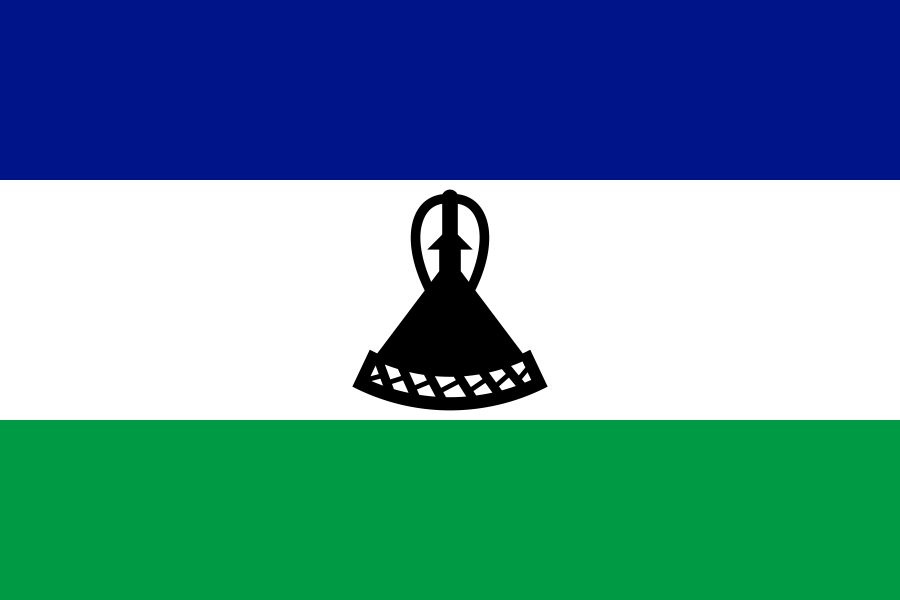
Lesotho
Data updated Oct 14, 2026
Overall Score
43.0
Fair
Avg. Rent (1BR)
$158
-91% vs US Avg
Safety Index
32.8
COL Index
26
Overall Score
43.0
FairEstimated Cost
$433/mo
single person, incl. rent
Verdict
Best for retirees
based on our recommended destinations
Level 2: Exercise Increased Caution
Please check the latest official travel advisory for Lesotho before planning your trip.
U.S. Department of State, verified Aug 28, 2026
Lesotho is not a retirement or remote work destination in any conventional sense. There's no retirement visa, no digital nomad visa, and nothing resembling a passive-income pathway into residency. The people who end up here are aid workers, missionaries, academics studying the region, or spouses of South African-based professionals who want a cheaper base an hour from Bloemfontein. If you're looking for a country to land in cold and build an expat life from scratch, this isn't it. If you have an institutional reason to be in Maseru already, the cost structure works in your favor.
The numbers look almost absurd on paper: $350 a month for a single person's living costs excluding rent, and $157.75 for a one-bedroom in the city center. That's not a marketing number, that's just what a small, low-income, landlocked economy costs. But the budget you build around those figures has to account for what Numbeo and cost-of-living calculators don't price well: imported goods, fuel, and anything beyond basic staples run higher than the headline numbers suggest because Lesotho imports most manufactured goods through South Africa. A realistic all-in monthly budget for a modest Western lifestyle, rent included, lands somewhere in the $600-900 range once you add transport, data, and the inevitable South African supermarket runs for things the local market doesn't stock.
The friction is healthcare and safety, full stop. The healthcare index sits at 44.2, and the safety index at 32.8, both well below what a Western expat is used to treating as background noise. Health insurance coverage is low across the country and most people pay out of pocket, which means anything beyond routine care means a drive into South Africa, and anything serious means Bloemfontein or further. Internet averages around 10 Mbps, workable for email and basic remote tasks but not for anyone relying on video calls as a primary work tool. English proficiency is rated medium, useful in government and business contexts but not something to lean on everywhere.
For a US citizen, Lesotho's tax system is straightforward on paper but doesn't buy you much. Top marginal income tax is 30%, with a 20% bracket up to roughly LSL 77,760 and 30% above that with no upper limit, plus a flat 25% on capital gains and a 25% dividend tax for standard residents. The Foreign Earned Income Exclusion for 2026 sits at $132,900, with a foreign housing exclusion base of $21,264 and a cap of $39,870, and those apply the same way they would anywhere else assuming you meet the physical presence or bona fide residence test. There's no structured confirmation of a US-Lesotho tax treaty, so don't assume treaty-based relief exists here the way it might in a country with a confirmed agreement. Whether any of this matters depends entirely on whether you're earning Lesotho-sourced income at all, which for most expats here, tied to foreign salaries or NGO funding, is unlikely.
Lesotho vs. the Southern Africa average
Scores out of 10, shown as the gap between Lesotho and the average of the 4 other countries in Southern Africa. 1 clear strength, 7 clear gaps.
- Cost of Living+0.5
- Residency Pathway0.0
- Tax Friendliness-0.6
- Safety-0.8
- Healthcare-0.8
- Expat Community-1.2
- Public Transport-1.9
- Internet Speed-2.2
- English Speaking-4.0
🚚 Moving to Lesotho
Planning the move? Compare free quotes from international movers.
Get a free moving cost estimate for moving to Lesotho. Takes 10 seconds.
How much are you shipping?
When are you moving?
Powered by Sirelo. Free quotes from international movers.
We may earn a commission if you request quotes through this tool.
Recommended Destinations in Lesotho
Best for Retirees
Best for Geoarbitrage
Best for Remote Workers
- Capital
- Maseru
- Official Language
- English, Sotho
- Time Zone
- UTC+02:00
- Region
- Africa
- Population
- 2,142,252
- Healthcare Index
- 44.2
- Internet Speed
- 10 Mbps
- Climate Zones
- temperate
View on Interactive Map
Explore data visually
🏙️ Top Cities in Lesotho
Explore cost of living, walkability scores, and expat ratings for individual cities in Lesotho.
CoL Index: 35
Est. Total: ~$543/mo
CoL Index: 32
Est. Total: ~$480/mo
How far does $1,500 go in Lesotho?
With a monthly budget of $1,500, you can live comfortably in Lesotho. After accounting for an average rent of $$158, you have approximately $1,342remaining for daily expenses.
Calculate your FIRE timeline with these costs →💰 Cost of Living in Lesotho
Relative to New York City (NYC = 100). A lower number means it's cheaper.
Estimate the cost of shipping your belongings to Lesotho →
See how Lesotho's cost of living compares with South Africa
🛒 Grocery & Family Costs
Family Costs
Can I afford to live in Lesotho?
Comfortable (1.0×): balanced baseline lifestyle. Adjusts day-to-day costs only — rent is unaffected.
Lesotho
You could save
2,492/mo
Monthly Costs
Attractiveness Scores
Based on national averages. City-level costs may vary. Browse cities in Lesotho →
⚕️ Healthcare System
Our Top Pick for Nomads: SafetyWing
Flexible, subscription-based health cover for remote workers in Lesotho.
Get Covered with SafetyWing →Looking for more options? Check Ekta.
An estimation of the overall quality of the health care system. Higher is better.
Quality & Affordability:
Health insurance coverage is low in Lesotho; most individuals rely on out-of-pocket payments. Public healthcare provides basic services but struggles with resource limitations and accessibility, especially in rural areas. Private healthcare is limited but offers better quality care.
Insurance Insights:
Health insurance coverage is low; most individuals rely on out-of-pocket payments.
See how Lesotho's healthcare compares with South Africa
🛂 Visa & Residency Pathways
🛂 Visa Services
Ready to apply for a Lesotho visa?
Get help with your application — tourist, long-stay, and residency visas processed online.
General Overview
Process & Requirements:
Lesotho, a landlocked nation surrounded by South Africa, has a 'complex' immigration system primarily focused on employment and business. The main route to residency is by obtaining a work permit sponsored by a local employer. There is no formal program for retirement or financially independent individuals. This means that long-term stays are almost exclusively for those with a pre-arranged job or who are starting a business that will employ local citizens.
The process is managed by the Ministry of Home Affairs. It can be bureaucratic and slow, and requires a clear, economic-based reason for being in the country. The lack of independent residency options makes it a challenging destination for those not in the workforce.
Residency & Citizenship Notes:
There is no formal pathway to permanent residency. The pathway to citizenship is 'complex'. The law allows for naturalization after five years of residence. However, the applicant must renounce their previous citizenship, as Lesotho's law does not permit dual citizenship. The process is also discretionary. The renunciation requirement is a significant barrier for most people, making citizenship a rarely pursued option for foreign residents.
🛂 Visa Matcher
See which Lesotho visas you qualify for
Answer 11 quick questions and get matched to the right visa for your situation.
Free · No signup required to see results
Detailed Visa Options
🧳 Tourist & Short-Stay Information
Extension Notes
A visa can be extended at the Department of Immigration in Maseru. It is recommended to apply before the current visa expires. Source: Lesotho Department of Immigration.
General Visa Notes
Lesotho has introduced an e-Visa system. US citizens can also obtain a visa on arrival, but the e-Visa is recommended. The stay is for up to 30 days. Passport must be valid for at least 6 months.
Official Source: View Source
🌴 Retirement / Passive Income Visa
This country does not have a dedicated retirement visa, but the following notes provide guidance on pathways for retirees.
Income Notes
Lesotho does not have a retirement visa program. Residence permits are typically issued for work, business, or study.
Official Source: http://www.homeaffairs.gov.ls/departments/immigration-services/
Health Insurance Notes
Lesotho does not have a retirement visa program. For other residence permits, applicants are required to show they will not be a public charge, making private medical insurance a necessity.
Official Source: http://www.homeaffairs.gov.ls/departments/immigration-services/
💻 Digital Nomad Visa
Income Notes
Lesotho does not have a digital nomad visa. The immigration system is designed for standard tourism or for work permits sponsored by a local employer. Source: Lesotho Ministry of Home Affairs.
Many long-stay visas require proof of health insurance. Compare international health plans before you apply.
Compare health insuranceWe may earn a commission at no cost to you.
🛡️ Safety & Stability
An estimation of overall safety level. Higher is better.
An estimation of the overall level of crime. Lower is better.
World Bank political stability estimate, rescaled to 0-100. Higher is better.
Safety Notes:
Crime Rate: High. Lesotho experiences high levels of crime, including violent crime.
Types of Crime: Armed robbery, assault, and burglary.
Kidnapping Risk: Moderate; incidents have occurred, particularly in urban areas.
🏦 Taxation & Finance
🏦 Tax Snapshot
FEIE Interaction
FTC Utility: low
Lesotho income tax rates top out at 30%, which is below the top US marginal rate of 37%. For most middle-income US expats, FEIE is more advantageous than the Foreign Tax Credit. FTC becomes useful only for high earners whose Lesotho tax liability on income above the FEIE exclusion amount exceeds what the US would otherwise impose. No US-Lesotho income tax treaty exists to simplify FTC calculations.
Presence Day Count Notes
US citizens and residents living in Lesotho can qualify for the FEIE via the bona fide residence test if they establish residence in Lesotho for a full tax year, or via the physical presence test by being present in a foreign country for at least 330 full days in any 12-month period. Lesotho qualifies as a foreign country for both tests.
FBAR Trigger Notes
FBAR filing required if aggregate balances in Lesotho financial accounts exceed $10,000 at any point during the calendar year. Lesotho uses the Loti (LSL) pegged to the South African Rand. US persons should track Lesotho bank and investment accounts. FinCEN Form 114 due April 15 with automatic extension to October 15.
401k/IRA Treatment
Pension Income
Foreign pension income is taxable in Lesotho for residents. Taxed at progressive PIT rates of 20% on the first LSL 68,892 and 30% above that threshold. No special exemption for foreign pensions exists.
Locally TaxedSocial Security
No US-Lesotho totalization or tax treaty. US Social Security benefits received by a Lesotho resident are not protected and would be included in worldwide taxable income under Lesotho domestic rules.
Locally TaxedRoth Distributions
No treaty protection. Roth distributions would be assessed under Lesotho domestic rules. Tax authority may treat these as income receipts absent treaty provisions excluding them. Qualification as a return of after-tax contributions is not recognized under Lesotho law.
Locally TaxedUS 401k/IRA Distributions
No tax treaty exists between the US and Lesotho. Distributions from US 401(k) or IRA accounts received by a Lesotho resident would be treated as foreign-source income. Lesotho taxes residents on worldwide income, so such distributions are likely subject to the standard progressive PIT rates of 20% and 30%. Tax rate depends on total income in the year of receipt.
Locally TaxedCapital Gains Tax
Capital gains in Lesotho are generally included in taxable income and subject to standard income or withholding tax. Gains on disposal of certain assets may attract withholding tax at 25%. No standalone capital gains tax regime exists.
Lesotho does not have a separate capital gains tax. Gains on disposal of assets are generally subject to withholding tax or included in business income. A 25% withholding tax applies on certain asset disposal proceeds paid to residents and non-residents.
Dividend Tax Rate
Dividends paid by Lesotho-resident companies are subject to a 25% withholding tax for non-residents. Resident individuals receiving dividends are also subject to withholding tax at 25%, which may be a final tax. No double tax treaty with the US exists, so no reduced treaty rate applies for US persons.
withholding
Rate: 25.0%
Standard withholding rate on dividends paid to both residents and non-residents. No US-Lesotho tax treaty to reduce this rate.
Tax Treaties Notes:
No US-Lesotho tax treaty. Taxes residents on worldwide income. High VAT (15%).
Retiree Tax Benefits:
No retiree programs. Residency tied to employment.
Cost Savings vs. U.S.:
Low costs (e.g., $700/month in Maseru). Limited healthcare.
Pick between Form 2555 (Foreign Earned Income Exclusion) and Form 1116 (Foreign Tax Credit) with an expat tax service.
Get help with my expat taxesWe may earn a commission at no cost to you.
Recommended services for Lesotho
Recommended Partner
Fidelity →See how Lesotho's taxes compares with South Africa
☀️ Climate & Environment
Climate Zones:
Our proprietary index for drinking water quality and sanitation. Higher is better.
Seasonal Variations:
Lesotho experiences a temperate climate with hot summers and cold winters. The country receives most of its rainfall during the summer months from October to April, while winters are dry and can be cold, especially in the highlands.
😊 Quality of Life
Cultural Amenities:
Museums & Cultural Institutions
The National Museum of Lesotho in Maseru offers exhibits on the country's history and culture.
The Morija Museum & Archives preserves and promotes Lesotho's cultural heritage.
Performing Arts
Traditional Basotho music and dance are integral to Lesotho's cultural performances.
The Morija Arts & Cultural Festival celebrates Lesotho's rich cultural traditions.
Cultural Festivals
The Morija Arts & Cultural Festival is an annual event held in Morija, a large village in the Maseru District of Lesotho.
Culinary Culture
Lesotho's cuisine includes dishes like papa (maize porridge) and moroho (spinach stew).
🌐 Infrastructure & Connectivity
Our proprietary ranking of public transit accessibility and reliability.
Internet Reliability:
Lesotho has average fixed broadband speed of approximately 10 Mbps.
Speed & Quality: Fixed broadband speeds are limited, with mobile networks providing primary connectivity, with mobile networks providing primary connectivity.
Availability: Limited fixed infrastructure, primarily in urban areas. Mobile coverage is expanding.
Cost: Relatively expensive for the region, typically $30-50/month for limited speeds.
Reliability for Remote Work: Challenging for remote work due to limited infrastructure and slower speeds. Mobile connectivity may be more reliable than fixed broadband.
Transportation Network:
Lesotho has limited transportation infrastructure as a mountainous landlocked country completely surrounded by South Africa.
Roads: Basic road network with many unpaved mountain roads that can be dangerous.
Rail: No railway system within Lesotho.
Domestic Travel: Small airports serve major towns; most transport relies on buses and taxis on challenging mountain roads.
Recommended services for Lesotho
Recommended Partner
Traveling Mailbox →Frequently Asked Questions about Lesotho
Click any question to expand the answer.
Share This Guide
Lesotho's rules change. We'll tell you when.
Visa, tax, and cost updates for Lesotho, before they catch you out. Free with RA Postcards.
By submitting your email address, you will receive a free subscription to RA Postcards and special offers from Rewire Abroad and our affiliates. You can unsubscribe at any time, and we encourage you to read more about our Privacy Policy.