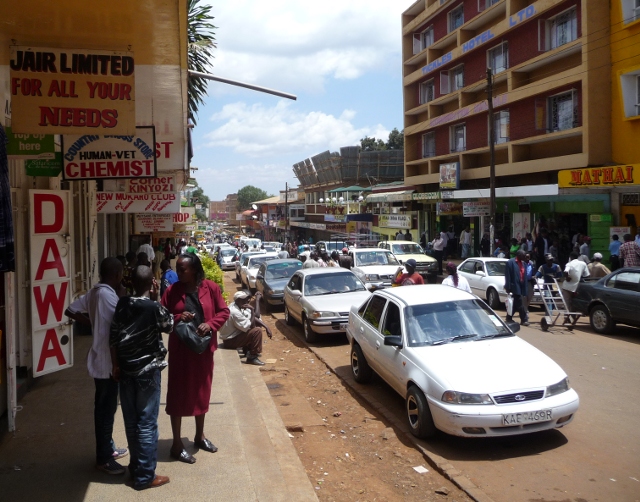
Nyeri sits high in the Kenyan highlands at 1,750 m above sea level, a temperate climate town of 99 thousand people in the Africa/Nairobi timezone. The altitude keeps the air cool and the pace unhurried, and the town's position between the Aberdare Range and Mount Kenya has long made it a stopover for travelers moving between the capital and the country's northern reaches. Expats who settle here tend to cluster in Nyeri Town Center and along Kimathi Way, where the streets are walkable, the markets are close, and daily errands do not require a car. The expat community is small, with no established expat neighborhood in the conventional sense, so newcomers often find their footing through work, church, or the local university rather than through an organized social scene.
Living costs in Nyeri are low even by Kenyan standards. A one-bedroom apartment in the city center rents for $92/mo, while the same unit outside the center drops to $69/mo. Three-bedroom units run $192/mo in the center and $154/mo outside it. Utilities come to about $15/mo, internet is $35/mo, and a mobile phone plan costs $12/mo. A monthly public transport pass is $15/mo, a gym membership is $35/mo, and an inexpensive restaurant meal runs $5 per person. A mid-range restaurant meal for two with three courses is $35, and a cappuccino costs $2. For a single adult, budget-tier living including rent totals $212/mo, mid-range totals $329/mo, and a comfortable tier totals $422/mo. Excluding rent, a single person spends around $480/mo and a family of four around $1,400/mo. Against those figures, the average monthly net salary locally is $231/mo, and the cost of living index sits at 35/100 with New York City at 100. The gap between local wages and expat budgets is wide, which means remote workers and retirees on foreign income live very differently from the people around them.
Safety in Nyeri is middling. The safety index is 50/100 and the crime index is 50/100, where a lower crime figure would be better. That places the town in moderate territory: not a place to be careless after dark, but not a place defined by danger either. Air quality is good, with an index of 35 where lower is better, helped by the elevation and the surrounding green belt. Healthcare quality is rated fair, which means routine care is available locally but serious or specialized treatment usually means a trip to Nairobi. English proficiency is common in tourist areas, so visitors and new residents can manage most everyday interactions, though Swahili and Kikuyu remain the languages of daily life outside those settings. Internet averages 18 Mbps, workable for email and video calls but not for heavy data work.
For stays, Kenya offers the Class K (Ordinary residents) retirement visa program, which requires a minimum monthly income of $2,000/mo, and the Kenya Digital Nomad Visa, which requires a minimum monthly income of $4,583/mo. The nearest airport is NYE, 6 km away. Nyeri scores 77/100 overall for expats, 79/100 on FIRE, 55/100 for retirees, and 49/100 for digital nomads. Those numbers tell a clear story: the town rewards people who already have income and want low costs, cool air, and quiet, and it suits retirees and slow-living remote workers more than it suits nomads who need fast connections and a ready social circle. Anyone expecting a built-up expat scene will be disappointed; anyone looking for a highland town where $212/mo covers a single adult at the budget tier will find the arithmetic hard to argue with.