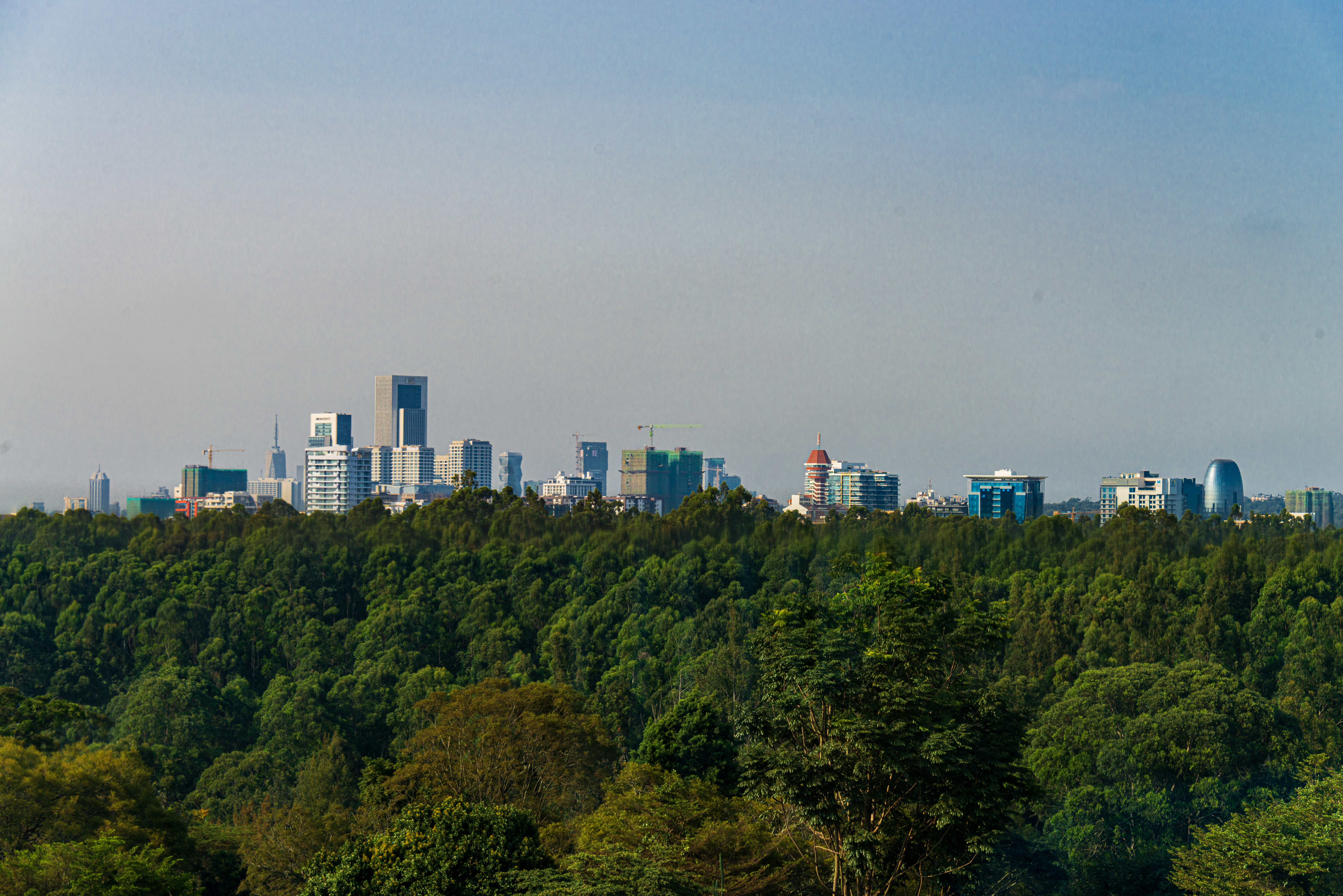
Nairobi sits high on the East African plateau at 1,795 m above sea level, a capital of 4.4 million people whose temperate climate rarely swings to extremes. The city keeps time on Africa/Nairobi, and its elevation gives mornings and evenings a cool edge that surprises first-time arrivals expecting tropical heat. Most expats settle in Westlands, Karen, or Gigiri, three neighborhoods that anchor the city's large and active expat community. Westlands hums with offices, restaurants, and apartment towers; Karen spreads out in leafy, low-density calm; Gigiri clusters around diplomatic missions and international organizations. English is widely spoken, which smooths the transition for newcomers who have not yet picked up Swahili.
The money conversation in Nairobi splits sharply between local wages and expat budgets. A one-bedroom apartment in the city center runs $445/mo, while the same unit outside the center drops to $217/mo. Three-bedroom units follow the same pattern: $1,121/mo in the center and $505/mo beyond it. Utilities add $56/mo, internet $35/mo, and a mobile phone plan $15/mo. A monthly public transport pass costs $46/mo, and a gym membership runs $50/mo. Eating out stays affordable, with an inexpensive restaurant meal at $6 per person, a mid-range three-course dinner for two at $35, and a cappuccino at $3. For a single adult, monthly costs excluding rent come to $579/mo, while a family of four faces $2,132/mo excluding rent. Budget, mid-range, and comfortable tiers for a single adult, rent included, land at $394/mo, $598/mo, and $909/mo respectively. Against that, the average monthly net salary locally is $478/mo, and the cost of living index sits at 33/100 against New York City at 100.
Safety in Nairobi asks for situational awareness rather than alarm. The safety index reads 45/100 and the crime index 55/100, where a lower crime figure means safer conditions. Air quality registers 62 on the index, where lower is better, and healthcare quality is rated fair. The practical response among residents is to choose neighborhoods deliberately, keep transport arrangements predictable, and treat medical care as something to plan for rather than assume. The city rewards that approach with a daily life that is far more varied than its reputation sometimes suggests.
For longer stays, Kenya offers the Class K (Ordinary residents) retirement visa program, which requires a minimum monthly income of $2,000/mo, and the Kenya Digital Nomad Visa, which requires a minimum monthly income of $4,583/mo. Wilson Airport (WIL) sits just 4 km from the city, putting arrivals within easy reach of the urban core. Nairobi scores 76/100 overall for expats, 78/100 on FIRE, 61/100 for retirees, and 71/100 for digital nomads. Average internet speed runs at 15 Mbps. The city suits remote workers, early retirees, and professionals tied to international organizations, especially those who want a temperate climate, a well-established expat network, and living costs that stretch considerably further than in the cities they left behind.