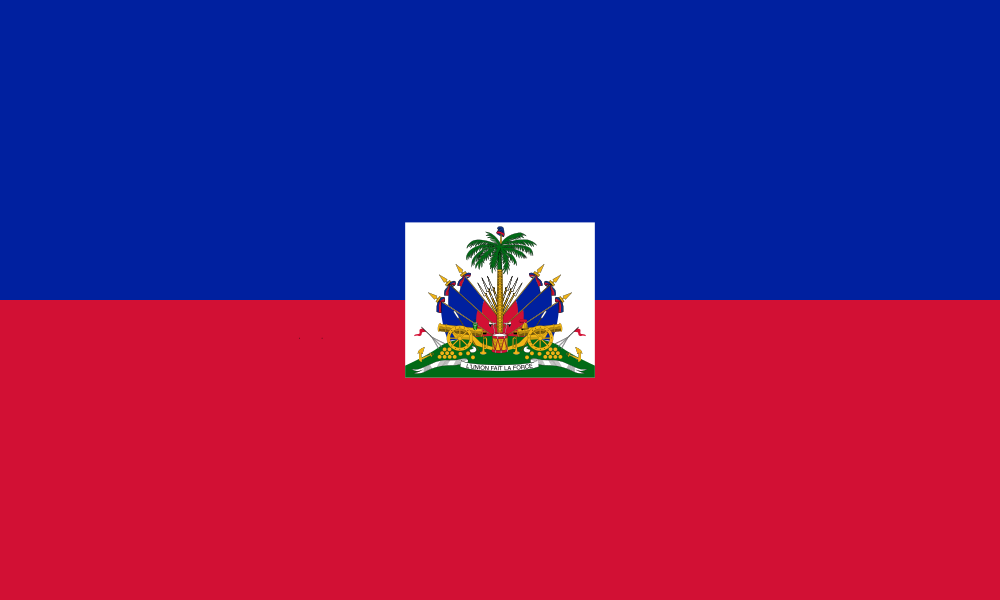
Haiti
Data updated Oct 14, 2026
Overall Score
5.2
Challenging
Avg. Rent (1BR)
$979
-42% vs US Avg
Safety Index
12.7
COL Index
30
Overall Score
5.2
ChallengingEstimated Cost
$1,821/mo
single person, incl. rent
Level 4: Do Not Travel
Please check the latest official travel advisory for Haiti before planning your trip.
U.S. Department of State, verified Aug 28, 2026
Haiti is not a retirement or FIRE destination by any normal definition, and it shouldn't be marketed as one. The security situation is serious enough that it isn't a place ordinary long-term residents plan around. The only Americans who realistically live here long term are missionaries, NGO staff, aid workers, and people with Haitian family ties who accept the security situation as a cost of being near relatives. If you're choosing a country off a spreadsheet of cost of living and weather, this isn't on the list.
The cost numbers look attractive until you check what they're measuring. Monthly expenses excluding rent run around $977.60, and a one-bedroom in a city center averages $978.67, so a basic single-person budget lands near $1,950 a month. That's not cheap for a country with no digital nomad visa and no retirement visa, and it's in the same range as parts of Mexico or Colombia that offer actual infrastructure and legal residency routes in return. The "low cost of living" pitch ignores that you're paying similar money for dramatically less security and almost no services.
The friction here isn't inconvenience, it's risk. The safety index sits at 12.7, among the lowest anywhere ranked, and the healthcare index is 23.1, reflecting a system that Wikipedia's own overview describes as underfunded and reliant on out-of-pocket payments and international aid, meaning a broken leg or a serious infection can mean medevac, not a clinic visit. English proficiency is low, so daily business runs in French or Haitian Creole. Internet averages 65.5 Mbps, which is workable for remote work on paper, but power reliability and physical security around where you work are the actual constraints, not bandwidth.
On tax, Haiti is not a place where US-specific structured treaty or dual-citizenship data has been confirmed, so don't assume either a treaty or a path to a second passport protects you here; verify directly before relying on either. What is clear is the domestic rate structure: Haiti taxes income on a bracket system that reaches a 30% top marginal rate above HTG 1,000,000, with capital gains taxed flat at 30% and dividends to non-residents at 20%. For a US citizen, the Foreign Earned Income Exclusion for 2026 is $132,900, with a foreign housing exclusion base of $21,264 and a cap of $39,870, and those numbers apply the same way they would anywhere else foreign earned income qualifies. The practical issue isn't the tax code, it's that almost nobody is structuring a retirement or remote-work life around Haitian tax residency in the first place.
Haiti vs. the Caribbean average
Scores out of 10, shown as the gap between Haiti and the average of the 12 other countries in Caribbean. 2 clear strengths, 7 clear gaps.
- Cost of Living+1.5
- Internet Speed+0.5
- Residency Pathway-1.3
- Tax Friendliness-1.4
- Public Transport-2.0
- Expat Community-3.1
- Healthcare-4.3
- Safety-4.6
- English Speaking-5.8
🚚 Moving to Haiti
Planning the move? Compare free quotes from international movers.
Get a free moving cost estimate for moving to Haiti. Takes 10 seconds.
How much are you shipping?
When are you moving?
Powered by Sirelo. Free quotes from international movers.
We may earn a commission if you request quotes through this tool.
Recommended Destinations in Haiti
Best for Retirees
Best for Geoarbitrage
Best for Remote Workers
- Capital
- Port-au-Prince
- Official Language
- French, Haitian Creole
- Time Zone
- UTC-05:00
- Region
- Latin America
- Population
- 11,402,533
- Healthcare Index
- 23.1
- Internet Speed
- 65.5 Mbps
View on Interactive Map
Explore data visually
🏙️ Top Cities in Haiti
Explore cost of living, walkability scores, and expat ratings for individual cities in Haiti.
CoL Index: 55
Est. Total: ~$1,650/mo
CoL Index: 35
Est. Total: ~$1,333/mo
CoL Index: 35
Est. Total: ~$2,974/mo
How far does $2,500 go in Haiti?
With a monthly budget of $2,500, you can live comfortably in Haiti. After accounting for an average rent of $$979, you have approximately $1,521remaining for daily expenses.
Calculate your FIRE timeline with these costs →💰 Cost of Living in Haiti
Relative to New York City (NYC = 100). A lower number means it's cheaper.
Estimate the cost of shipping your belongings to Haiti →
See how Haiti's cost of living compares with Saint Kitts and Nevis
🛒 Grocery & Family Costs
Family Costs
Can I afford to live in Haiti?
Comfortable (1.0×): balanced baseline lifestyle. Adjusts day-to-day costs only — rent is unaffected.
Haiti
You could save
1,044/mo
Monthly Costs
Attractiveness Scores
Based on national averages. City-level costs may vary. Browse cities in Haiti →
⚕️ Healthcare System
Our Top Pick for Nomads: SafetyWing
Flexible, subscription-based health cover for remote workers in Haiti.
Get Covered with SafetyWing →Looking for more options? Check Ekta.
An estimation of the overall quality of the health care system. Higher is better.
Quality & Affordability:
Haiti's healthcare system includes public and private sectors. The public sector comprises the Ministry of Health and Population (MSPP) and a social security institution (Ofatma). The system faces challenges such as low expenditure per capita and recent disruptions due to gang violence.
Insurance Insights:
Health services are underfunded, leading to reliance on out-of-pocket payments and international aid.
See how Haiti's healthcare compares with Saint Kitts and Nevis
🛂 Visa & Residency Pathways
🛂 Visa Services
Ready to apply for a Haiti visa?
Get help with your application — tourist, long-stay, and residency visas processed online.
General Overview
Process & Requirements:
The system for long-term residency in Haiti is 'complex', significantly hampered by political instability and institutional weakness. While a legal framework exists for obtaining a residence permit (permis de séjour), the process is known for being extremely bureaucratic, slow, and unpredictable. A residence permit is typically granted on the basis of work (sponsored by a local company), investment, or family ties. There are no formal programs for retirees or financially independent individuals.
Most expats in Haiti are there for specific work with NGOs, international organizations, or businesses. The application is submitted to the Haitian Immigration and Emigration service. The process often requires the help of a local lawyer or facilitator to navigate the system. The 'complex' score reflects the deep administrative challenges rather than overtly difficult legal requirements.
Residency & Citizenship Notes:
There is no pathway to permanent residency. The pathway to citizenship is 'complex' and has a long residency requirement. A foreigner can apply for naturalization after ten years of continuous residence in Haiti. However, the process is discretionary and not commonly pursued by expats. The Haitian constitution has complex and historically restrictive clauses regarding nationality and land ownership by foreigners. While some changes have been made to allow for dual citizenship in some cases, the overall path to citizenship remains an unclear and difficult one for foreign residents.
🛂 Visa Matcher
See which Haiti visas you qualify for
Answer 11 quick questions and get matched to the right visa for your situation.
Free · No signup required to see results
Detailed Visa Options
🧳 Tourist & Short-Stay Information
Extension Notes
Extensions beyond 90 days require applying for a residence permit from the Haitian Immigration Service. Source: Haiti Directorate of Immigration.
General Visa Notes
US citizens can enter Haiti for up to 90 days without a visa. A tourist fee must be paid upon arrival at the airport. A passport valid for at least six months is required. The U.S. Dept of State advises against travel due to security concerns.
Official Source: View Source
🌴 Retirement / Passive Income Visa
This country does not have a dedicated retirement visa, but the following notes provide guidance on pathways for retirees.
Income Notes
Haiti does not offer a retirement visa. Due to the current political and security instability, options for long-term residency for foreign nationals are not formalized or viable. Source: General knowledge from official travel advisories.
Health Insurance Notes
Haiti does not have a retirement visa program. Due to the ongoing political and security instability, standard immigration procedures are not in effect. Any visitor is advised to have comprehensive medical insurance with emergency evacuation. Source: General knowledge from official travel advisories.
💻 Digital Nomad Visa
Income Notes
Haiti does not have a digital nomad visa. Due to the extremely volatile security situation and political instability, consular services are minimal and long-term stays for remote work are not feasible or advisable. Source: Most government travel advisories.
📈 Investor Visa
Investment Details
Investment Options & Notes
Due to extreme political instability and security issues, Haiti does not have a functioning residency by investment program. Source: N/A
Path to Citizenship
Many long-stay visas require proof of health insurance. Compare international health plans before you apply.
Compare health insuranceWe may earn a commission at no cost to you.
🛡️ Safety & Stability
An estimation of overall safety level. Higher is better.
An estimation of the overall level of crime. Lower is better.
World Bank political stability estimate, rescaled to 0-100. Higher is better.
Safety Notes:
Crime Rate: High. Haiti experiences high levels of crime, including violent crime and civil unrest.
Types of Crime: Armed robbery, assault, kidnapping, and gang-related violence.
Kidnapping Risk: High; incidents are common, particularly in Port-au-Prince and other urban areas.
🏦 Taxation & Finance
🏦 Tax Snapshot
FEIE Interaction
FTC Utility: low
Haiti's top marginal income tax rate is 30%, below the US top federal rate. However, given the very low average incomes and limited formal employment in Haiti, most US expats working there may have total Haitian tax liability that is modest relative to their US tax obligation. Tax administration and collection are weak, meaning actual taxes paid to Haiti may be low, reducing the pool of creditable foreign taxes. FEIE is generally more advantageous than FTC for most US expats in Haiti.
Presence Day Count Notes
Standard IRS 330-day rule applies for the physical presence test. Haiti is not excluded from FEIE eligibility. However, the US State Department has issued a Level 4 Do Not Travel advisory for Haiti due to gang violence and civil unrest. The advisory does not automatically disqualify FEIE but taxpayers should ensure their presence days and residency claims are well documented. Bona fide residence may be difficult to establish given the security environment and practical difficulties in maintaining a stable residence.
FBAR Trigger Notes
US persons with Haitian financial accounts (e.g., accounts at Unibank, Sogebank, or BNC) exceeding $10,000 aggregate at any point in the calendar year must file FinCEN 114 (FBAR). FATCA Form 8938 thresholds also apply. Haiti is not a FATCA IGA partner as of the last verified date, so Haitian banks may have inconsistent FATCA compliance. US expats should maintain records of all local accounts.
401k/IRA Treatment
Pension Income
Foreign pension income received by Haitian residents is subject to the standard progressive income tax rates. No special exemption or reduced rate applies to pension income. Rate is determined by the taxpayer's total income bracket.
Locally TaxedSocial Security
No US-Haiti totalization agreement or income tax treaty exists. US Social Security benefits received by a Haitian tax resident are treated as foreign income and are technically subject to Haitian income tax. Practical enforcement is minimal.
Locally TaxedRoth Distributions
No treaty protection and no domestic exemption for Roth distributions. Amounts received may be included in taxable income. Haiti does not recognize the Roth structure as tax-exempt. Practical enforcement is uncertain given limited DGI capacity.
Locally TaxedUS 401k/IRA Distributions
No US-Haiti income tax treaty exists. Distributions from US 401(k) or IRA accounts received by a Haitian tax resident are treated as foreign-source income and are subject to Haitian income tax under the standard progressive schedule. Practical enforcement on foreign pension income is limited but no legal exemption exists. Rate depends on total taxable income for the year.
Locally TaxedCapital Gains Tax
Haiti does not have a separate capital gains tax regime. Gains from asset disposals are generally included in ordinary income and taxed at standard rates. Top marginal rate of 30% applies. Tax administration in Haiti is governed by the Direction Generale des Impots (DGI). Enforcement capacity is limited and practical application varies.
No standalone capital gains tax exists. Gains are folded into general income and subject to the progressive individual income tax schedule. The top rate of 30% applies to the highest bracket.
Dividend Tax Rate
Dividends paid by Haitian companies to non-residents are subject to a withholding tax. The standard withholding rate on dividends is 20%. Resident individuals receiving dividends may have them included in taxable income. Haiti has very few tax treaties in force, so treaty rate reductions are rarely available to US expats.
withholding
Rate: 20.0%
Standard withholding rate on dividends paid to non-residents, including US persons. No US-Haiti income tax treaty exists, so no reduced treaty rate applies.
Tax Treaties Notes:
Haiti does not have an income tax treaty with the United States, which may result in potential double taxation for U.S. citizens residing there.
Retiree Tax Benefits:
Haiti does not offer special tax benefits for foreign retirees. Foreign pension income received by residents is taxed at standard progressive rates. U.S. citizens must comply with U.S. tax obligations on their global income.
Cost Savings vs. U.S.:
Haiti offers a lower cost of living compared to the United States; however, considerations regarding infrastructure and healthcare quality are important factors for retirees.
Pick between Form 2555 (Foreign Earned Income Exclusion) and Form 1116 (Foreign Tax Credit) with an expat tax service.
Get help with my expat taxesWe may earn a commission at no cost to you.
Recommended services for Haiti
Recommended Partner
Fidelity →See how Haiti's taxes compares with Saint Kitts and Nevis
☀️ Climate & Environment
Our proprietary index for drinking water quality and sanitation. Higher is better.
😊 Quality of Life
Cultural Amenities:
Museums & Cultural Institutions
Haiti offers a range of museums that immerse visitors into world-class art, exciting history, and science.
Performing Arts
Haitian music and dance are celebrated around the world, reflecting the country's rich cultural heritage.
Cultural Festivals
Haiti hosts a season of festivals that showcase its natural beauty and vibrant culture.
Culinary Culture
Haitian cuisine includes dishes like griot, tassot, and diri ak djon djon, highlighting its African and French influences.
🌐 Infrastructure & Connectivity
Our proprietary ranking of public transit accessibility and reliability.
Internet Reliability:
Haiti faces severe internet infrastructure challenges due to economic instability and limited investment.
Speed & Quality: Fixed broadband averages 65.5 Mbps with very limited fiber coverage and patchy mobile networks.
Availability: Limited coverage concentrated in Port-au-Prince, minimal rural connectivity.
Cost: Expensive relative to local economy, around $40-80/month for available higher-speed options.
Reliability for Remote Work: Not suitable for reliable remote work due to infrastructure limitations, frequent outages, and economic instability.
Transportation Network:
Haiti has very poor transportation infrastructure, severely impacted by poverty, natural disasters, and political instability.
Roads: Road network is in very poor condition with many unpaved and dangerous routes.
Rail: No functioning railway system in the country.
Domestic Travel: Very limited domestic flights; most transport relies on buses and motorcycles on poor roads.
Recommended services for Haiti
Recommended Partner
Traveling Mailbox →Frequently Asked Questions about Haiti
Click any question to expand the answer.
Share This Guide
Haiti's rules change. We'll tell you when.
Visa, tax, and cost updates for Haiti, before they catch you out. Free with RA Postcards.
By submitting your email address, you will receive a free subscription to RA Postcards and special offers from Rewire Abroad and our affiliates. You can unsubscribe at any time, and we encourage you to read more about our Privacy Policy.