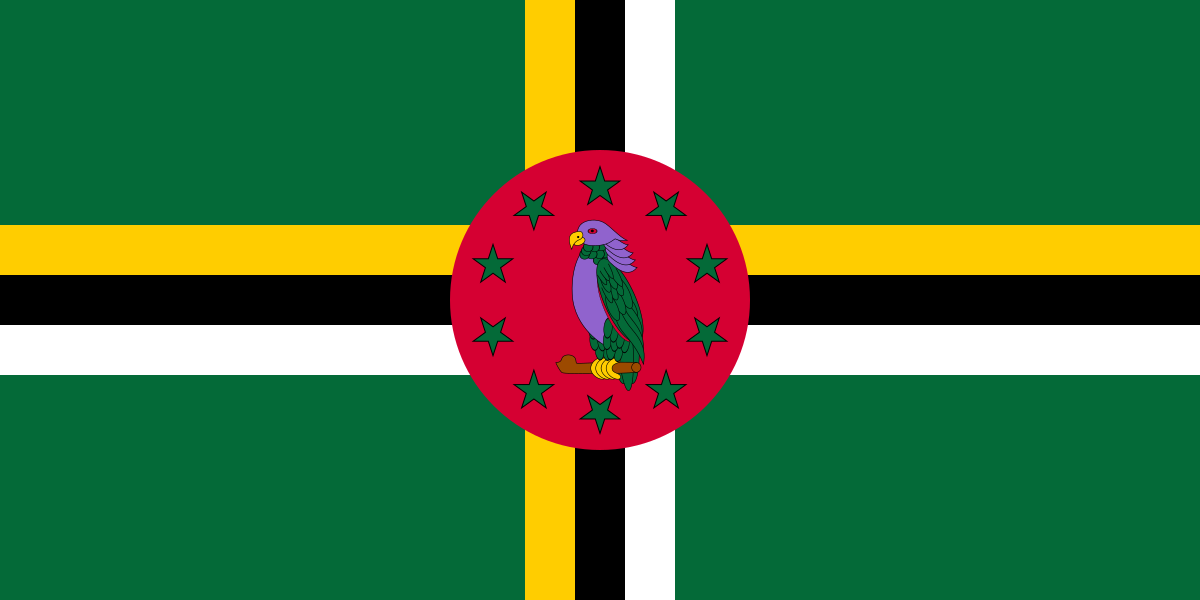
Dominica
Data updated Oct 14, 2026
Overall Score
61.4
Good
Avg. Rent (1BR)
$284
-83% vs US Avg
Safety Index
64.3
COL Index
34.4
Overall Score
61.4
GoodEstimated Cost
$1,196/mo
single person, incl. rent
Verdict
Best for retirees
based on our recommended destinations
Dominica works for a specific type of person: someone who wants a quiet, English-speaking Caribbean island, doesn't need a retirement visa to justify the move, and is fine trading nightlife and infrastructure for nature and low rent. There's no digital nomad visa and no dedicated retirement or passive-income visa here, so anyone planning to stay long-term is working through standard residence permits, not a marketed expat track. This is a better fit for someone already drawn to diving, hiking, and a slower pace than for someone chasing a visa-run-free remote work setup.
The baseline numbers look good on paper: $973.70 a month for a single person's costs before rent, and $283.68 for a 1BR near the city center. Add those together and you're near $1,260 a month for a modest but real budget, before flights, imported goods, or anything resembling specialized healthcare. Public healthcare services are free, though limited, and private care exists mainly for those willing to pay out of pocket or seek specialized care elsewhere.
Internet is the practical friction point most people underestimate: average speeds around 25 Mbps mean video calls and remote work are workable but not seamless, and outages during storm season are a real planning variable, not a footnote. Banking, imports, and anything requiring fast bureaucratic turnaround move slower than US expectations, and the lack of a digital nomad visa means remote workers need to sort out their legal status on a case-by-case basis rather than relying on a template.
For US tax purposes, Dominica's local income tax runs on a bracket system up to 35% at the top, with 0% up to EC$30,000, climbing through 15% up to EC$50,000, 25% up to EC$80,000, and then 35% with no upper cap. Capital gains for individuals are untaxed, and dividends paid to non-residents are taxed at 15% (residents' dividends are generally exempt), both relevant if you're generating investment income while there. The Foreign Earned Income Exclusion for 2026 lets you shield up to $132,900 of earned income from US tax, with a foreign housing exclusion on top (base $21,264, cap $39,870), which matters if you're actually earning a salary or self-employment income while resident rather than living off US-sourced passive income that doesn't qualify for the FEIE. Citizenship by residence requires just one year, notably fast, but that's a separate track from the tax question and doesn't change your US filing obligations, which continue regardless of where you live.
Dominica vs. the Caribbean average
Scores out of 10, shown as the gap between Dominica and the average of the 12 other countries in Caribbean. 4 clear strengths, 2 clear gaps.
- Safety+2.6
- English Speaking+1.8
- Cost of Living+1.1
- Healthcare+0.6
- Expat Community-0.1
- Tax Friendliness-0.5
- Internet Speed-1.3
🚚 Moving to Dominica
Planning the move? Compare free quotes from international movers.
Get a free moving cost estimate for moving to Dominica. Takes 10 seconds.
How much are you shipping?
When are you moving?
Powered by Sirelo. Free quotes from international movers.
We may earn a commission if you request quotes through this tool.
Recommended Destinations in Dominica
Best for Retirees
Best for Geoarbitrage
Best for Remote Workers
- Capital
- Roseau
- Official Language
- English
- Time Zone
- UTC-04:00
- Region
- Latin America
- Population
- 71,991
- Healthcare Index
- 53.9
- Internet Speed
- 25 Mbps
View on Interactive Map
Explore data visually
🏙️ Top Cities in Dominica
Explore cost of living, walkability scores, and expat ratings for individual cities in Dominica.
CoL Index: 34
Est. Total: ~$934/mo
CoL Index: 34
Est. Total: ~$1,233/mo
CoL Index: 34
Est. Total: ~$2,173/mo
How far does $1,500 go in Dominica?
With a monthly budget of $1,500, you can live comfortably in Dominica. After accounting for an average rent of $$284, you have approximately $1,216remaining for daily expenses.
Calculate your FIRE timeline with these costs →💰 Cost of Living in Dominica
Relative to New York City (NYC = 100). A lower number means it's cheaper.
Estimate the cost of shipping your belongings to Dominica →
See how Dominica's cost of living compares with Saint Kitts and Nevis
🛒 Grocery & Family Costs
Family Costs
Can I afford to live in Dominica?
Comfortable (1.0×): balanced baseline lifestyle. Adjusts day-to-day costs only — rent is unaffected.
Dominica
You could save
1,743/mo
Monthly Costs
Attractiveness Scores
Based on national averages. City-level costs may vary. Browse cities in Dominica →
⚕️ Healthcare System
Our Top Pick for Nomads: SafetyWing
Flexible, subscription-based health cover for remote workers in Dominica.
Get Covered with SafetyWing →Looking for more options? Check Ekta.
An estimation of the overall quality of the health care system. Higher is better.
Quality & Affordability:
Dominica's government provides free public healthcare services at major healthcare centers and numerous clinics. The system is grounded in a strong primary healthcare approach.
Insurance Insights:
Public healthcare services are free, with private options available for those seeking specialized care.
See how Dominica's healthcare compares with Saint Kitts and Nevis
🛂 Visa & Residency Pathways
🛂 Visa Services
Ready to apply for a Dominica visa?
Get help with your application — tourist, long-stay, and residency visas processed online.
General Overview
Available Visa Types:
🛂 Visa Matcher
See which Dominica visas you qualify for
Answer 11 quick questions and get matched to the right visa for your situation.
Free · No signup required to see results
Detailed Visa Options
📈 Investor Visa
Investment Details
Path to Citizenship
Many long-stay visas require proof of health insurance. Compare international health plans before you apply.
Compare health insuranceWe may earn a commission at no cost to you.
🛡️ Safety & Stability
An estimation of overall safety level. Higher is better.
World Bank political stability estimate, rescaled to 0-100. Higher is better.
Safety Notes:
Crime Rate: Low. Dominica is generally safe, with occasional petty crimes. The island's safety index score is 64.3.
Types of Crime: Theft and burglary, particularly in tourist areas.
Kidnapping Risk: Very low; no significant threat reported.
🏦 Taxation & Finance
🏦 Tax Snapshot
FEIE Interaction
FTC Utility: low
Dominica's top personal income tax rate is 25%, which is lower than the top US federal rate of 37%. For many US expats, the FEIE is the preferred mechanism. If Dominican income tax is actually paid, a foreign tax credit can reduce US liability on income exceeding the FEIE limit, but the relatively low Dominican rates mean the FTC offsets less US tax than in higher-tax jurisdictions.
Presence Day Count Notes
The physical presence test requires 330 full days outside the US in any 12-month period. Dominica is an eligible foreign country for this purpose. Days spent in Dominica count toward the 330-day requirement.
FBAR Trigger Notes
US persons with financial accounts at Dominican institutions exceeding $10,000 in aggregate must file FinCEN 114. Dominica's banking sector includes several offshore-licensed banks under the National Bank of Dominica and a handful of smaller commercial banks. Account holders should track all accounts including those at ECCU-member institution branches.
401k/IRA Treatment
Pension Income
Foreign pension income remitted to or received in Dominica by a tax resident may be subject to income tax at the standard progressive rates. Dominica does not maintain a comprehensive list of exempt pension types equivalent to treaty countries. Rate depends on total taxable income.
Locally TaxedSocial Security
No US-Dominica tax treaty exists. US Social Security benefits received by a Dominican resident are foreign-source income. Dominican tax practice generally does not tax foreign pension-type income for non-domiciled individuals, but formal statutory guidance is limited.
Not Taxed LocallyRoth Distributions
Roth distributions are generally after-tax contributions returned to the account holder. Dominican tax law does not have specific provisions addressing Roth accounts. Because Dominica taxes on a territorial or remittance basis for certain income types, in practice many foreign-source distributions may not be taxed, but this carries uncertainty given the absence of a treaty and limited published guidance.
Not Taxed LocallyUS 401k/IRA Distributions
Dominica has no tax treaty with the United States. US 401k and IRA distributions received by a resident of Dominica would be treated as foreign-source income and potentially subject to Dominican income tax under general rules. The applicable rate depends on total income and the standard progressive brackets (0%, 15%, 25%). No specific exemption or treaty protection exists.
Locally TaxedCapital Gains Tax
Dominica does not levy a capital gains tax on individuals or corporations. Gains from asset disposals are generally not subject to tax.
No capital gains tax exists in Dominica. Asset disposals do not generate a separate taxable event for either individuals or companies.
Dividend Tax Rate
Dominica imposes withholding tax on dividends paid to non-residents. Dividends received by residents from Dominican companies are generally exempt from further income tax at the individual level. The standard withholding rate on dividends paid to non-residents is 15%.
withholding
Rate: 15.0%
Applied to dividends paid to non-resident recipients
exempt
Rate: 0.0%
Dividends received by resident individuals from local companies are generally not subject to additional income tax
Tax Treaties Notes:
Dominica does not have an income tax treaty with the United States, which may result in potential double taxation for U.S. citizens residing in Dominica. However, the two countries have an intergovernmental agreement to implement FATCA, facilitating the exchange of tax information.
Retiree Tax Benefits:
Dominica does not offer a special tax program for foreign retirees. U.S. citizens must comply with U.S. tax obligations on their global income.
Cost Savings vs. U.S.:
Dominica offers a lower cost of living compared to the United States, with affordable housing and utilities, making it appealing for retirees.
Pick between Form 2555 (Foreign Earned Income Exclusion) and Form 1116 (Foreign Tax Credit) with an expat tax service.
Get help with my expat taxesWe may earn a commission at no cost to you.
Recommended services for Dominica
Recommended Partner
Fidelity →See how Dominica's taxes compares with Saint Kitts and Nevis
☀️ Climate & Environment
Seasonal Variations:
Dominica has a tropical climate with two main seasons: a dry season from December to May and a wet season from June to November. The island receives abundant rainfall, especially in the interior, and is prone to hurricanes during the wet season.
😊 Quality of Life
🌐 Infrastructure & Connectivity
Recommended services for Dominica
Recommended Partner
Traveling Mailbox →Frequently Asked Questions about Dominica
Click any question to expand the answer.
Share This Guide
Dominica's rules change. We'll tell you when.
Visa, tax, and cost updates for Dominica, before they catch you out. Free with RA Postcards.
By submitting your email address, you will receive a free subscription to RA Postcards and special offers from Rewire Abroad and our affiliates. You can unsubscribe at any time, and we encourage you to read more about our Privacy Policy.