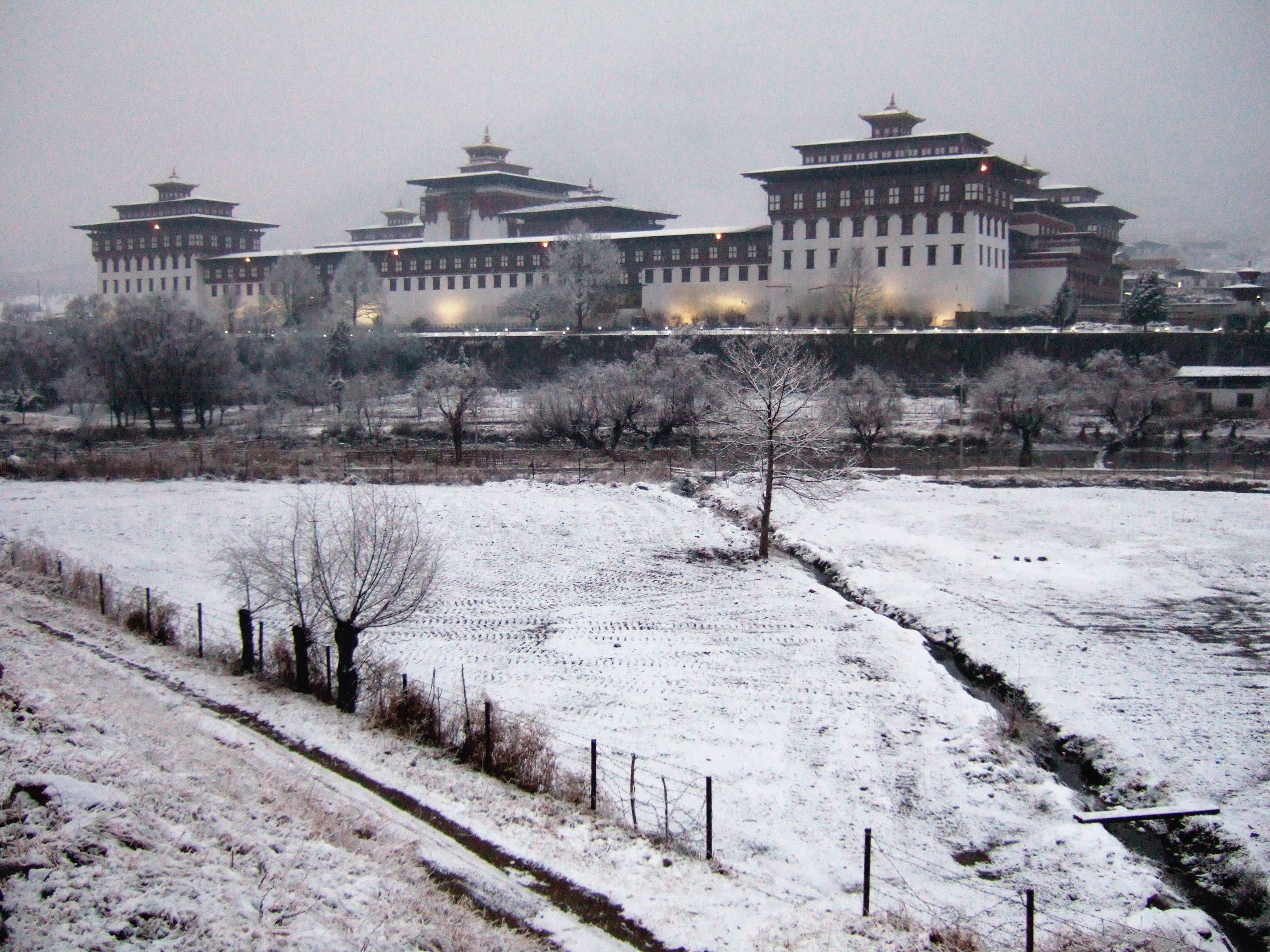
Thimphu, the capital of Bhutan, sits at an elevation of 2334 meters above sea level in the Himalayas, a city of roughly 115 thousand people. Its temperate climate brings cool, dry winters with lows around -6°C from December to February, and mild, wet summers with highs around 25°C from June to September, accompanied by high humidity at 83% and significant monsoon rainfall. Expats tend to cluster in Thimphu City Centre, Chang Lam, and Kawajangsa, where daily life unfolds against a backdrop of traditional architecture and steep valleys, though the small expat community means newcomers often integrate quickly into local rhythms.
Living costs here are strikingly low by global standards, with a cost of living index of 29 out of 100 relative to New York City. A one-bedroom apartment in the city centre rents for $127/mo, dropping to $86/mo outside the centre, while a three-bedroom in the centre costs $190/mo and $155/mo outside. For a single adult, a budget tier total including rent comes to $236/mo, a mid-range tier to $346/mo, and a comfortable tier to $422/mo, with utilities at $34/mo, internet at $24/mo, and a mobile plan at $36/mo. The average monthly net salary is $344/mo, which aligns closely with the comfortable tier, and a monthly public transport pass costs just $5/mo, while an inexpensive restaurant meal runs $3 and a mid-range three-course meal for two is $14.
Safety is a defining feature of Thimphu, with a safety index of 75 out of 100 and a crime index of 25 out of 100, indicating very low crime. Healthcare quality is rated as good, and the air quality index stands at 45, which is moderate but acceptable. For those considering a longer stay, the city offers a stable environment, though English proficiency is limited, so learning basic Dzongkha or relying on translation apps becomes practical for daily interactions.
For remote workers, Bhutan offers the Bhutan Digital Nomad Visa, which requires a minimum monthly income of $364/mo, a threshold that is easily met by many freelancers and employees. The nearest airport is PBH, located 47 km away, making arrival straightforward via regional connections. Thimphu suits those prioritizing low costs, safety, and a slower pace of life, particularly retirees and FIRE-focused individuals, given its retiree score of 67 out of 100 and FIRE score of 87 out of 100, though digital nomads may find the average internet speed of 10 Mbps limiting, reflected in a digital nomad score of 53 out of 100.