Belarus
Data updated Oct 14, 2026
Overall Score
37.9
Fair
Avg. Rent (1BR)
$451
-73% vs US Avg
Safety Index
50.2
COL Index
25
Overall Score
37.9
FairEstimated Cost
$804/mo
single person, incl. rent
Level 4: Do Not Travel
Please check the latest official travel advisory for Belarus before planning your trip.
U.S. Department of State, verified Aug 28, 2026
Belarus is not a retirement or remote work destination, and it shouldn't be on anyone's shortlist unless you have a specific reason to be there: a Belarusian spouse, a job transfer, or academic ties. There is no digital nomad visa and no retirement or passive-income visa, so the legal path in is narrow regardless of your financial situation.
The cost numbers look attractive on paper. A single person can cover monthly expenses, excluding rent, for about $527, and a 1BR apartment in the city center runs roughly $450 a month, putting total living costs under $1,000. That undercuts most of Central Europe. But cheap costs mean nothing if you can't get a visa to live there long-term, and the low English proficiency rating means you'll be navigating banking, leases, and medical visits in Russian or Belarusian with no fallback.
The practical friction starts with the healthcare system, which scores 48.5 on standard indexes, well below what Americans are used to. Foreign residents can access the public system, and private insurance is available cheaply and may get you better doctors, but this is not a country to be in for a serious medical event if you can avoid it. The safety index sits at 50.2, middling by European standards. Day-to-day life also means operating largely outside the Euro-zone travel ecosystem: EES has been checking entries and exits at EU borders since October 2025, and ETIAS isn't running yet, so if you're using Belarus as a base for regional travel, plan for friction at every border crossing.
For a US expat who ends up with Belarusian tax residency, the domestic tax brackets are steep at the top: 13% up to BYN 350,000, climbing to 25% up to BYN 600,000, and 30% above that with no ceiling. Capital gains for individuals are taxed at a progressive 13%, and dividends at 13% up to BYN 350,000/year of aggregate income, 25% above that threshold. There is a special expat tax program available, worth asking a local accountant about before assuming you'll pay the headline rates. On the US side, the Foreign Earned Income Exclusion for 2026 is $132,900, with a foreign housing exclusion base of $21,264 and a cap of $39,870, and those still apply regardless of where you're posted. Whether a tax treaty softens double taxation here isn't settled in available records, so don't assume treaty relief without checking with someone who specializes in this corridor before you move.
Belarus vs. the Eastern Europe & Caucasus average
Scores out of 10, shown as the gap between Belarus and the average of the 6 other countries in Eastern Europe & Caucasus. 2 clear strengths, 6 clear gaps.
- Public Transport+1.7
- Cost of Living+0.6
- Housing Affordability+0.4
- Tax Friendliness-0.2
- Healthcare-0.9
- English Speaking-1.0
- Residency Pathway-1.3
- Air Quality-1.7
- Safety-1.9
- Expat Community-2.2
🚚 Moving to Belarus
Planning the move? Compare free quotes from international movers.
Get a free moving cost estimate for moving to Belarus. Takes 10 seconds.
How much are you shipping?
When are you moving?
Powered by Sirelo. Free quotes from international movers.
We may earn a commission if you request quotes through this tool.
Recommended Destinations in Belarus
Best for Retirees
Best for Geoarbitrage
Best for Remote Workers
- Capital
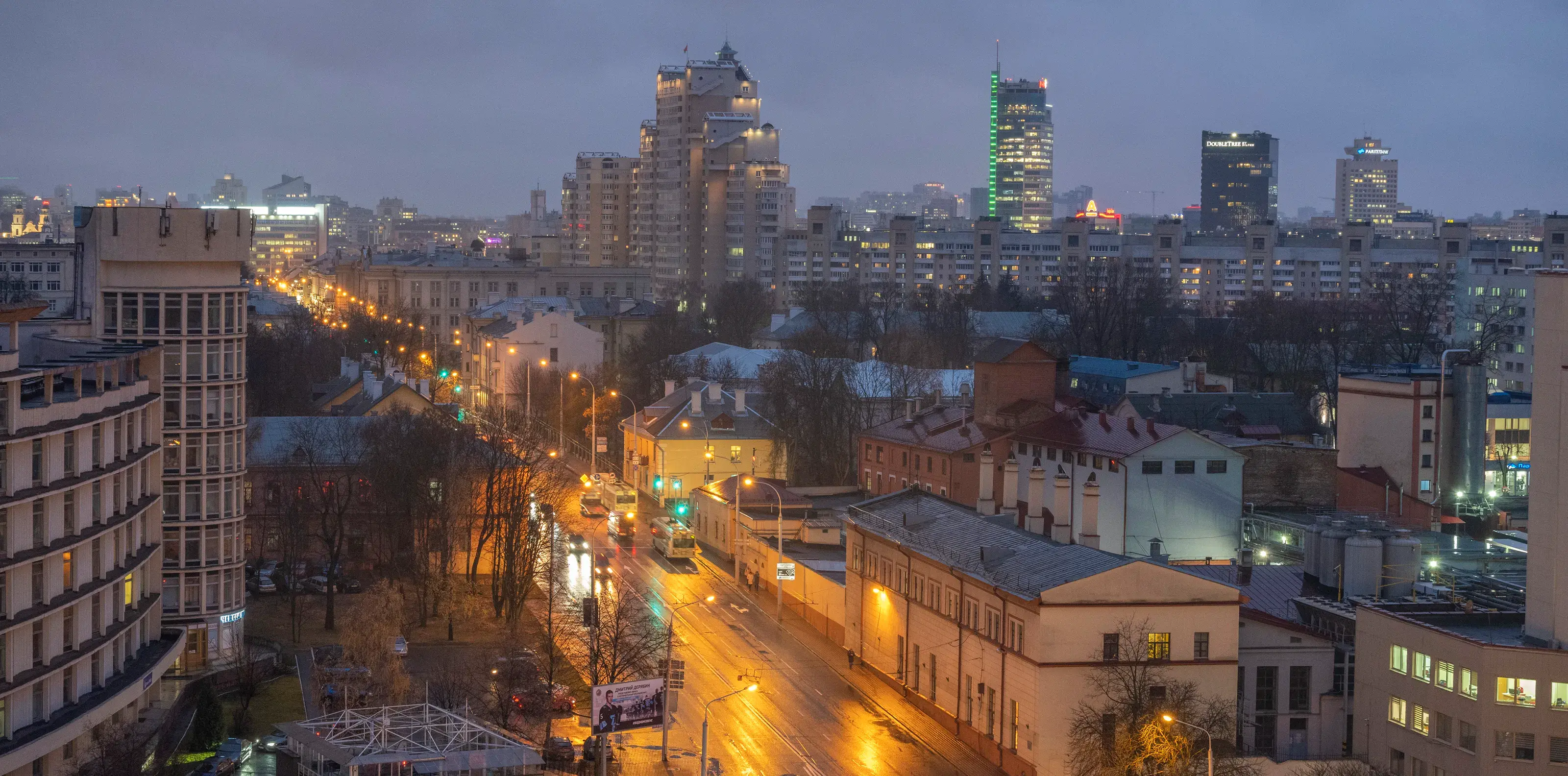
- Minsk
- Official Language
- Belarusian, Russian
- Time Zone
- UTC+03:00
- Region
- Europe
- Population
- 9,398,861
- Healthcare Index
- 48.5
- Climate Zones
- continental
View on Interactive Map
Explore data visually
🏙️ Top Cities in Belarus
Explore cost of living, walkability scores, and expat ratings for individual cities in Belarus.
CoL Index: 33
Est. Total: ~$1,144/mo
CoL Index: 29
Est. Total: ~$660/mo
CoL Index: 29
Est. Total: ~$685/mo
CoL Index: 29
Est. Total: ~$724/mo
CoL Index: 29
Est. Total: ~$690/mo
CoL Index: 28
Est. Total: ~$769/mo
CoL Index: 28
Est. Total: ~$752/mo
CoL Index: 28
Est. Total: ~$620/mo
CoL Index: 30
Est. Total: ~$787/mo
CoL Index: 27
Est. Total: ~$580/mo
CoL Index: 27
Est. Total: ~$610/mo
CoL Index: 27
Est. Total: ~$610/mo
CoL Index: 25
Est. Total: ~$573/mo
CoL Index: 25
Est. Total: ~$580/mo
CoL Index: 24
Est. Total: ~$560/mo
CoL Index: 25
Est. Total: ~$557/mo
CoL Index: 28
Est. Total: ~$660/mo
CoL Index: 27
Est. Total: ~$640/mo
CoL Index: 27
Est. Total: ~$640/mo
CoL Index: 27
Est. Total: ~$550/mo
How far does $1,500 go in Belarus?
With a monthly budget of $1,500, you can live comfortably in Belarus. After accounting for an average rent of $$451, you have approximately $1,049remaining for daily expenses.
Calculate your FIRE timeline with these costs →💰 Cost of Living in Belarus
Relative to New York City (NYC = 100). A lower number means it's cheaper.
Relative to New York City (NYC = 100). A lower number means rent is cheaper.
Relative to New York City (NYC = 100). A lower number means groceries are cheaper.
Relative to New York City (NYC = 100). A lower number means eating out is cheaper.
Estimate the cost of shipping your belongings to Belarus →
See how Belarus's cost of living compares with Georgia
🛒 Grocery & Family Costs
Family Costs
Can I afford to live in Belarus?
Comfortable (1.0×): balanced baseline lifestyle. Adjusts day-to-day costs only — rent is unaffected.
Belarus
You could save
2,022/mo
Monthly Costs
Attractiveness Scores
Based on national averages. City-level costs may vary. Browse cities in Belarus →
⚕️ Healthcare System
Our Top Pick for Nomads: SafetyWing
Flexible, subscription-based health cover for remote workers in Belarus.
Get Covered with SafetyWing →Looking for more options? Check Ekta.
An estimation of the overall quality of the health care system. Higher is better.
Quality & Affordability:
Public healthcare system is free for citizens and residents, rated fairly low on global indices, though global rankings are low and it may not be as advanced as Western systems. Private care is also available and relatively affordable.
Insurance Insights:
Foreign residents have access to the public system. Private health insurance is available at relatively low cost and may offer access to potentially higher quality care or specific doctors.
See how Belarus's healthcare compares with Georgia
🛂 Visa & Residency Pathways
🛂 Visa Services
Ready to apply for a Belarus visa?
Get help with your application — tourist, long-stay, and residency visas processed online.
General Overview
Process & Requirements:
Belarus's residency system is 'complex' and heavily influenced by state control and bureaucracy. The primary pathways for long-term residency are through employment with a local company, investment in a business, or having Belarusian heritage. The process requires a local sponsor (employer) to navigate the approvals from the Ministry of Internal Affairs. There are no formal programs for retirees or passive income earners, making independent residency very challenging.
The political climate and international sanctions also add a layer of complexity and uncertainty for citizens of many Western countries. The process is not transparent, and decisions can be arbitrary. The lack of accessible independent routes results in a low score.
Residency & Citizenship Notes:
The pathway to permanent residency is 'complex' due to the seven-year timeline and bureaucracy. The pathway to citizenship is also 'complex'. After seven years of permanent residence, a person can apply for naturalization. The applicant must have a source of income and demonstrate knowledge of one of the state languages (Belarusian or Russian). The most significant challenge is that Belarus requires applicants to renounce their previous citizenship, as dual citizenship is not generally recognized. This makes the path to citizenship a difficult choice for most foreigners.
🛂 Visa Matcher
See which Belarus visas you qualify for
Answer 11 quick questions and get matched to the right visa for your situation.
Free · No signup required to see results
Detailed Visa Options
🧳 Tourist & Short-Stay Information
Extension Notes
The 30-day visa-free stay is strictly not extendable. You must exit the country on or before the 30th day. Source: Ministry of Foreign Affairs of the Republic of Belarus.
General Visa Notes
US citizens can enter Belarus visa-free for up to 30 days only if they arrive and depart via Minsk National Airport. This does not apply to land crossings or flights to/from Russia. Proof of medical insurance ($10,000 coverage) and funds ($25/day) are required.
Official Source: View Source
🌴 Retirement / Passive Income Visa
This country does not have a dedicated retirement visa, but the following notes provide guidance on pathways for retirees.
Income Notes
Belarus does not have a retirement visa program. A temporary residence permit may be issued for reasons such as work, study, or marriage to a Belarusian citizen, but not for passive income retirement.
Official Source: https://mfa.gov.by/en/visa/
Health Insurance Notes
Belarus does not have a retirement visa program. For any temporary residence permit, compulsory medical insurance from a Belarusian state-authorized provider (Belgosstrakh or Beleximgarant) is mandatory.
Official Source: https://mfa.gov.by/en/visa/
💻 Digital Nomad Visa
Income Notes
Belarus does not have a visa or residence permit specifically for digital nomads. All foreign nationals intending to work must obtain a special work permit, which is tied to a specific Belarusian employer. Source: Ministry of Internal Affairs of the Republic of Belarus.
📈 Investor Visa
Investment Details
Investment Options & Notes
A foreigner can obtain a permanent residence permit by making an investment of at least €150,000 into any object of investment activity in Belarus. This is a direct path to permanent residency. Source: Law of the Republic of Belarus 'On the Legal Status of Foreign Citizens and Stateless Persons'.
Path to Citizenship
Citizenship Notes
After 7 years of continuous permanent residence, an investor can apply for citizenship. The applicant must have a knowledge of one of the state languages (Belarusian or Russian). Dual citizenship is not recognized. Source: Law of the Republic of Belarus 'On Citizenship'.
Many long-stay visas require proof of health insurance. Compare international health plans before you apply.
Compare health insuranceWe may earn a commission at no cost to you.
🛡️ Safety & Stability
An estimation of overall safety level. Higher is better.
An estimation of the overall level of crime. Lower is better.
World Bank political stability estimate, rescaled to 0-100. Higher is better.
Safety Notes:
Crime Rate: Belarus has a low to moderate crime rate. Petty crime occurs, especially in urban areas.
Types of Crime: Pickpocketing and theft are the most common crimes. Political repression and human rights issues are concerns.
Kidnapping Risk: Rare; however, political detentions have been reported.
🏦 Taxation & Finance
🏦 Tax Snapshot
High-Technology Park (HTP) Special Regime
Belarus HTP (incl. Great Stone Industrial Park) provides reduced taxation for resident IT/tech companies and their employees. Multiple 2026 aggregator sources (TaxAtlas, taxratesbycountry) report HTP employees pay a reduced 9% personal income tax (vs the general 13-30% scale) plus 1% employee social security, though this is not independently confirmed on a primary Belarusian government tax page in this review and should be verified directly with HTP administration before relying on it. HTP resident companies pay a reduced ~9-12% effective corporate burden via CIT exemptions and reduced dividend withholding. Separate from any general expat regime — there is no preferential personal income tax rate for expats outside the HTP/FEZ context; they are subject to the same 13/25/30% progressive scale as residents once tax-resident.
FEIE Interaction
FTC Utility: medium
Belarus's progressive PIT scale (13/25/30%) is generally below comparable US marginal rates at most income levels, though the 25-30% bands on high earners (above BYN 350,000-600,000/year) approach or can exceed typical effective US rates, making FTC more useful for higher earners than under the prior flat-13% regime. The FEIE remains the more straightforward tool for earners in the 13% band. Sanctions and the Level 4 US travel advisory create practical documentation complications.
Presence Day Count Notes
US citizens/green card holders in Belarus can qualify for FEIE via the physical presence test (330 days outside the US in 12 months) or bona fide residence test. Belarus tax residency triggers at 183 days/year. The US State Department maintains a Level 4 Do Not Travel advisory for Belarus, which may complicate bona fide residence claims and physical presence in practice.
FBAR Trigger Notes
US persons with Belarus financial accounts exceeding $10,000 in aggregate must file FinCEN 114 (FBAR). Belarus is not a FATCA-IGA jurisdiction as of 2026, and access to Belarusian banking has become significantly more difficult for US persons due to sanctions, de-risking by Belarusian banks, and the suspension of treaty provisions with 'unfriendly' countries through 2026.
401k/IRA Treatment
Pension Income
Foreign pension income received by Belarus tax residents is aggregated with other annual income and subject to the progressive scale: 13% up to BYN 350,000/year, 25% from BYN 350,000-600,000, 30% above BYN 600,000. Belarus state pensions paid to resident pensioners are generally not subject to PIT.
Locally TaxedSocial Security
US Social Security benefits received by Belarus tax residents may be partially addressed under the 1973 US-USSR treaty as applied to Belarus, though its application to Social Security specifically remains an area of interpretive uncertainty. Amounts not protected by treaty would be taxed at the progressive 13/25/30% scale as foreign-source income.
Locally TaxedTreaty ProtectedRoth Distributions
Belarus does not recognize the Roth IRA structure. Distributions would likely be treated as foreign-source income subject to the progressive 13/25/30% scale. The US-Belarus treaty does not explicitly address Roth accounts.
Locally TaxedUS 401k/IRA Distributions
The 1973 US-Belarus tax treaty (as successor to the USSR treaty) provides some general relief, but its application to 401k/IRA distributions specifically is not definitively settled. Absent clear treaty protection, distributions are taxed as foreign-source income at the progressive 13/25/30% scale depending on aggregate annual income. Residents are taxed on worldwide income.
Locally TaxedTreaty ProtectedCapital Gains Tax
As of 1 January 2025, capital gains on the sale of shares in Belarusian companies by individuals — previously exempt — are now taxed at 13%, aggregated with other annual income and subject to the same progressive scale as ordinary income (13% up to BYN 350,000/yr, 25% from BYN 350,000-600,000, 30% above BYN 600,000). Gains on sale of a first residential property within a 5-year holding period and one vehicle per year remain exempt. Corporate capital gains are included in ordinary taxable profit at the standard 20% CIT rate (25% for banks/insurers or where annual profit exceeds BYN 25 million).
Belarus does not have a standalone capital gains tax. Gains are folded into the progressive personal income tax scale (13/25/30%). Since 1 January 2025, gains from sale of shares in Belarusian companies (previously exempt) are now taxable. Real property held over 5 years and one vehicle sale per year remain exempt for individuals. Corporate gains are taxed at the standard 20% CIT rate (25% above BYN 25m profit or for banks/insurers).
Dividend Tax Rate
Belarus maintains a separate two-tier scale for dividends, mirroring the general PIT reform: 13% on dividend income up to BYN 350,000/year of aggregate income, 25% above that threshold (source: Natalya Kuleshova, Belarus parliament, Dec 2025 / BelTA). The previously preferential 6% rate (for companies that withheld profit distribution 5+ years) was abolished from 1 January 2026; the 0% rate is being phased out by 2027-2028. Dividends paid to non-resident individuals/foreign organizations are subject to withholding of up to 25% (raised from 15%), though application of treaty relief to 'unfriendly' countries (incl. US, EU, UK) has been suspended through end of 2026 under a 2024 Council of Ministers resolution.
progressive
Rate: 13.0%
Applies to total annual income (including dividends, wages, civil-contract income) up to BYN 350,000.
progressive
Rate: 25.0%
Applies to total annual income, including dividends, exceeding BYN 350,000.
withholding
Rate: 25.0%
Withholding rate on dividends paid to foreign (non-resident) organizations as of 2025-2026, up from 15%; treaty relief currently suspended for 'unfriendly' jurisdictions through end of 2026.
phasing out
Rate: 0.0%
Preferential 6% rate (5-year non-distribution condition) abolished from 1 Jan 2026; the 0% rate (reinvestment condition) is being phased out by approximately 2027-2028.
Tax Treaties Notes:
Belarus is technically covered by the 1973 US-CIS (formerly USSR) income tax treaty, according to the IRS. However, as of 2026, there is effectively no working treaty. There is no US-Belarus Totalization Agreement, meaning potential double social security taxation for self-employed expats.
Retiree Tax Benefits:
No special retiree tax regime exists, and retirement visas are not offered. General US expat tax rules and Belarusian domestic tax laws apply. US Social Security benefits may be received, but Medicare coverage is generally not available abroad.
Cost Savings vs. U.S.:
No direct cost comparison found. Belarus has relatively low progressive income tax rates (13%, 25%, or 30% depending on income level). US expats can utilize the Foreign Earned Income Exclusion (FEIE) and Foreign Tax Credits (FTC) to mitigate US tax liability, but the ambiguity around the treaty's current application and the absence of a totalization agreement can lead to double taxation in some areas (like social security for self-employed).
Pick between Form 2555 (Foreign Earned Income Exclusion) and Form 1116 (Foreign Tax Credit) with an expat tax service.
Get help with my expat taxesWe may earn a commission at no cost to you.
Recommended services for Belarus
Recommended Partner
Fidelity →See how Belarus's taxes compares with Georgia
☀️ Climate & Environment
Climate Zones:
Our proprietary index measuring annual average PM2.5 concentration. Lower is better (0-5 is good).
Our proprietary index for drinking water quality and sanitation. Higher is better.
Seasonal Variations:
Belarus features a continental climate with cold winters and warm summers. The country experiences two short transitional seasons—spring and autumn—with varying temperatures and precipitation.
😊 Quality of Life
Cultural Amenities:
Museums & Cultural Institutions
Belarus hosts numerous art exhibitions, musicals, theatrical performances, and cinema festivals.
Museums and monuments showcase the nation's rich heritage.
Performing Arts
The country has a dynamic art culture with various performances accessible to the public.
Theater and music are integral to cultural expressions.
Cultural Festivals
Festivals celebrate traditional music, dance, and communal activities.
Events often involve community participation and ancestral values.
Culinary Culture
Belarusian cuisine includes dishes like draniki (potato pancakes) and borscht.
Dairy products and hearty stews are central to the culinary scene.
🌐 Infrastructure & Connectivity
Our proprietary ranking of public transit accessibility and reliability.
Internet Reliability:
Belarus has decent internet infrastructure in urban areas, though subject to government restrictions and monitoring.
Speed & Quality: Fixed broadband averages around 95 Mbps in cities, with improving fiber networks.
Availability: Good coverage in urban areas, more limited in rural regions.
Cost: Relatively affordable, typically $15-30/month for residential broadband.
Reliability for Remote Work: Technically capable but subject to government internet restrictions and monitoring. Political situation may affect service stability.
Transportation Network:
Belarus has well-developed transportation infrastructure inherited from the Soviet era with ongoing maintenance.
Roads: Extensive road network connecting all major cities with good maintenance.
Rail: Comprehensive rail network serving domestic and international routes.
Domestic Travel: Good domestic flight connections; extensive bus and rail services provide comprehensive coverage.
Recommended services for Belarus
Recommended Partner
Traveling Mailbox →Frequently Asked Questions about Belarus
Click any question to expand the answer.
📚 Related Reading
Share This Guide
Belarus's rules change. We'll tell you when.
Visa, tax, and cost updates for Belarus, before they catch you out. Free with RA Postcards.
By submitting your email address, you will receive a free subscription to RA Postcards and special offers from Rewire Abroad and our affiliates. You can unsubscribe at any time, and we encourage you to read more about our Privacy Policy.